Flexible Thinking in Autism: How DIR Floortime Can Help
DIR Floortime works on flexible thinking in autism. Small shared problems offer chances to try another idea.

DIR Floortime works on flexible thinking in autism. Small shared problems offer chances to try another idea.
Key Points:
Flexible thinking in autism means noticing when a plan no longer works and considering another response. A favorite cup may be in the dishwasher, or a toy train track may come apart. DIR Floortime gives children opportunities to work through these moments with another person.
At Building Butterflies, we use child-led DIR Floortime therapy to work on communication and problem-solving. Your child’s interests give us a starting point for exploring what can happen when the expected plan changes.
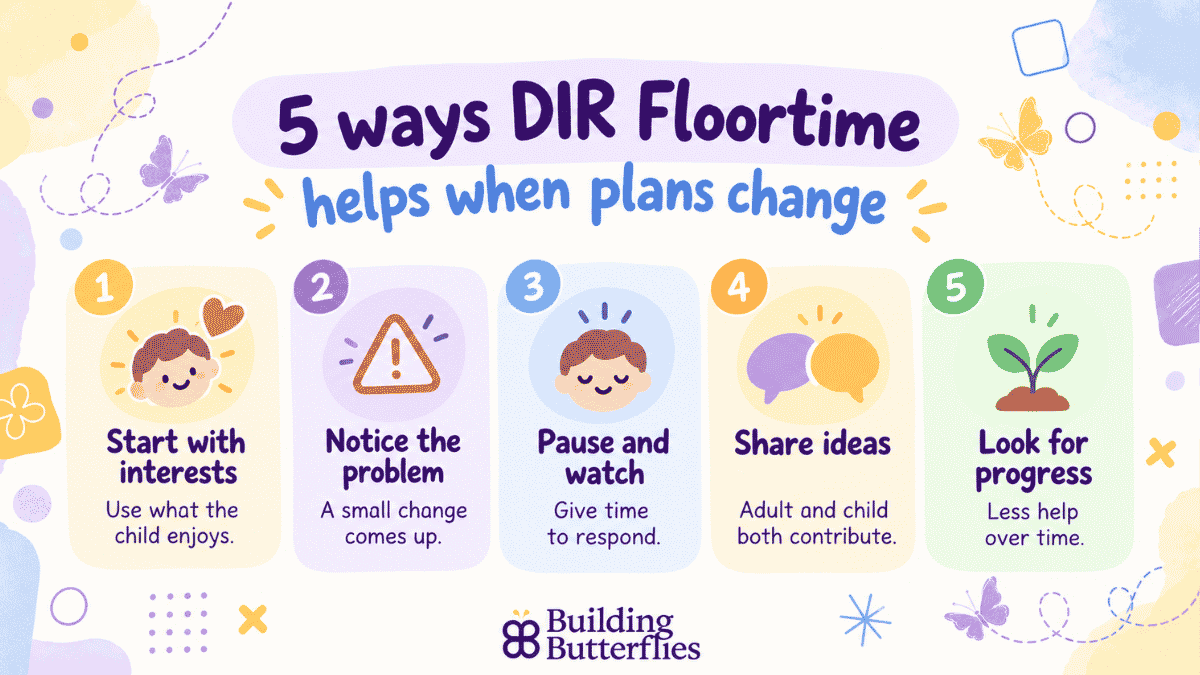
Flexible thinking can involve changing one part of a plan while keeping its purpose. A child who wants to finish a puzzle might turn a piece, try another space, or involve someone who can help.
Flexibility does not require a child to agree with every suggestion. A child can dislike a changed plan and still contribute to deciding what happens next. For example, “I want to go tomorrow” offers another possibility when today’s park visit falls through.
Research on cognitive flexibility in autism shows substantial differences between people. A review of 59 studies found greater difficulties overall among autistic participants without intellectual disabilities, but individual results varied. The review did not test DIR Floortime.
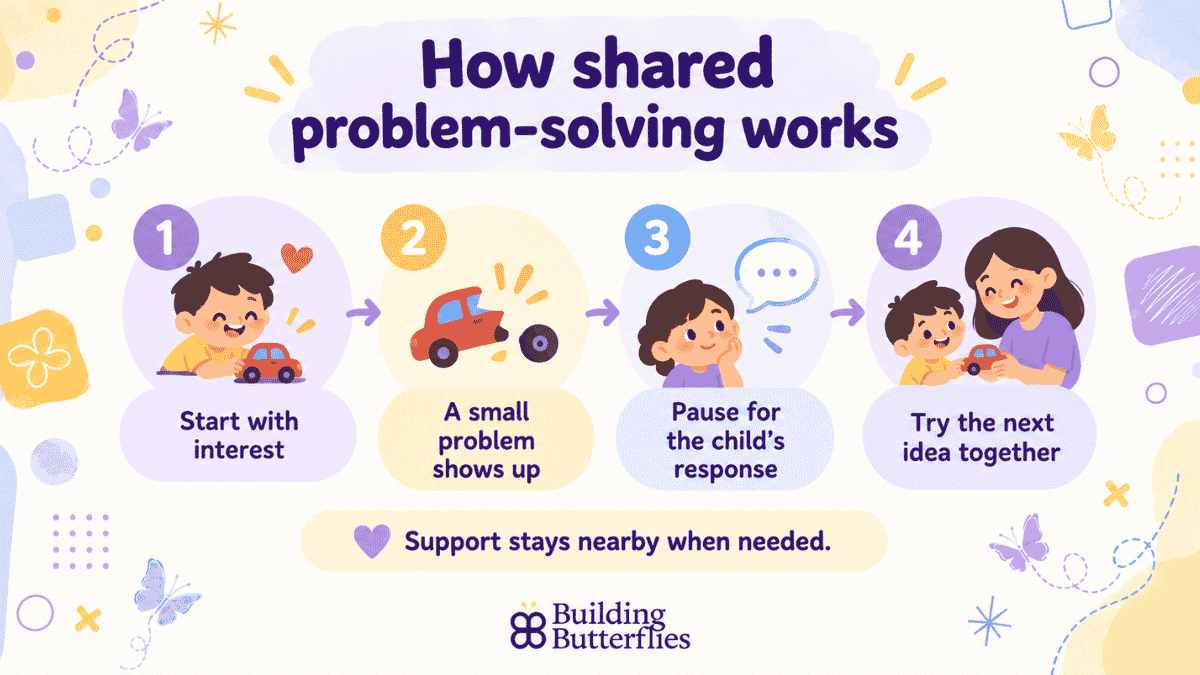
Shared problem-solving in DIR means working through a difficulty together using back-and-forth communication. The International Council on Development and Learning includes complex communication and shared problem-solving among the model’s developmental capacities. Gestures and actions can carry these exchanges before a child uses spoken sentences.
A DIR Floortime problem-solving interaction can follow this sequence:
The adult’s pause gives the child room to participate. Help stays available when the child needs it. Our explanation of communication during DIR Floortime explores how these exchanges can include different ways of sending a message.
Everyday problems offer chances to explore alternatives. The following examples illustrate possible responses; they do not describe children in our care or promise a particular result.
Our in-home DIR Floortime therapy includes caregiver participation and problem-solving with familiar activities. Our school-based support includes classroom observation and teacher collaboration. These settings let us work with families and educators around situations that occur during the child’s day.
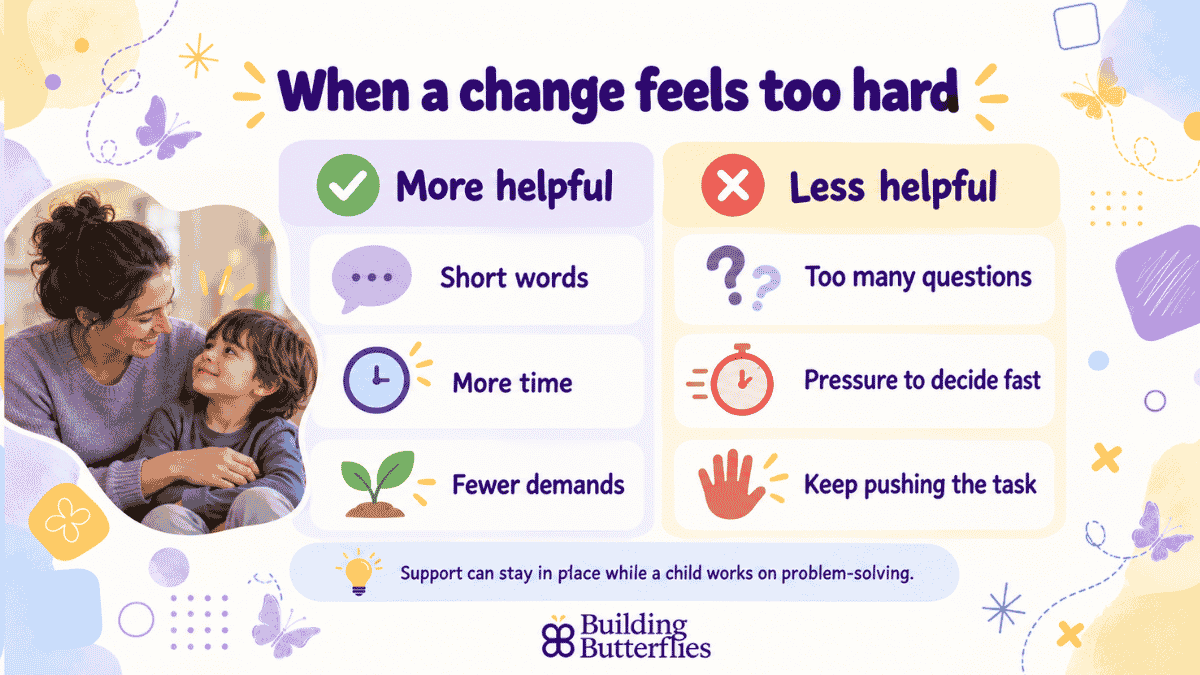
A child’s distress deserves attention. Familiar routines can provide comfort and predictability, and harmless preferences do not need changing simply to practice flexibility.
The National Autistic Society describes support for unexpected changes, including preparation, backup options, and time to process information. These supports can remain part of daily life while a child works on problem-solving.
During a difficult moment, support might include:
Your child’s individual differences help explain which responses may feel manageable. A quieter space or more familiar activity may be appropriate before another attempt at shared problem-solving.
Adults do not need to hide favorite items or repeatedly disrupt routines to create practice. Natural problems already offer opportunities to respond together.
Progress can appear before a child handles a major schedule change easily. Comparing similar situations helps families notice what the child contributed and how much assistance they needed.
A brief note might read:
“The track broke. Last week, I repaired it immediately. Today, my child brought me a connecting piece and showed me where it belonged.”
That observation describes participation without assuming that every future change will become easier. Another day may require more support.
Our home-based services include tracking progress and reviewing treatment plans. Specific examples from daily life can help connect those reviews with the goals a family wants to work on.
A child can use full sentences and still find it difficult to consider another option. Spoken language alone does not show how someone responds when an expected plan changes. A child’s own experiences give the team more information than vocabulary alone.
Visual schedules can help a child understand what to expect, including a planned change. A schedule can show that an activity has moved or that another option is available. Predictability and opportunities to make decisions can work together.
DIR Floortime also addresses developmental challenges beyond autism. At Building Butterflies, we support children with developmental, communication, and social-emotional needs. A conversation with our team can focus on the difficulties affecting your child’s daily activities.
Flexible problem-solving gives a child a role in what happens after something goes wrong. A recent example from home or school can help a family describe the support their child needs.
At Building Butterflies, we offer DIR Floortime in home, school, and clinic settings across New Jersey. Our team can speak with you about your child’s experiences and available services. A call to (973) 899-1816 or a message through our contact form can begin that conversation.

Your child holds incredible potential. At Building Butterflies, we use DIR Floortime Therapy to nurture development at the root, not just the surface, helping them connect, communicate, and flourish.
Contact us now to find out if your child can benefit from DIR Floortime Therapy.


©2026 Building Butterflies. All rights reserved.
Website Created By: Summit Group
