What Does “DIR” Stand For?

D - Developmental
I - Individual Differences
R - Relationship-Based
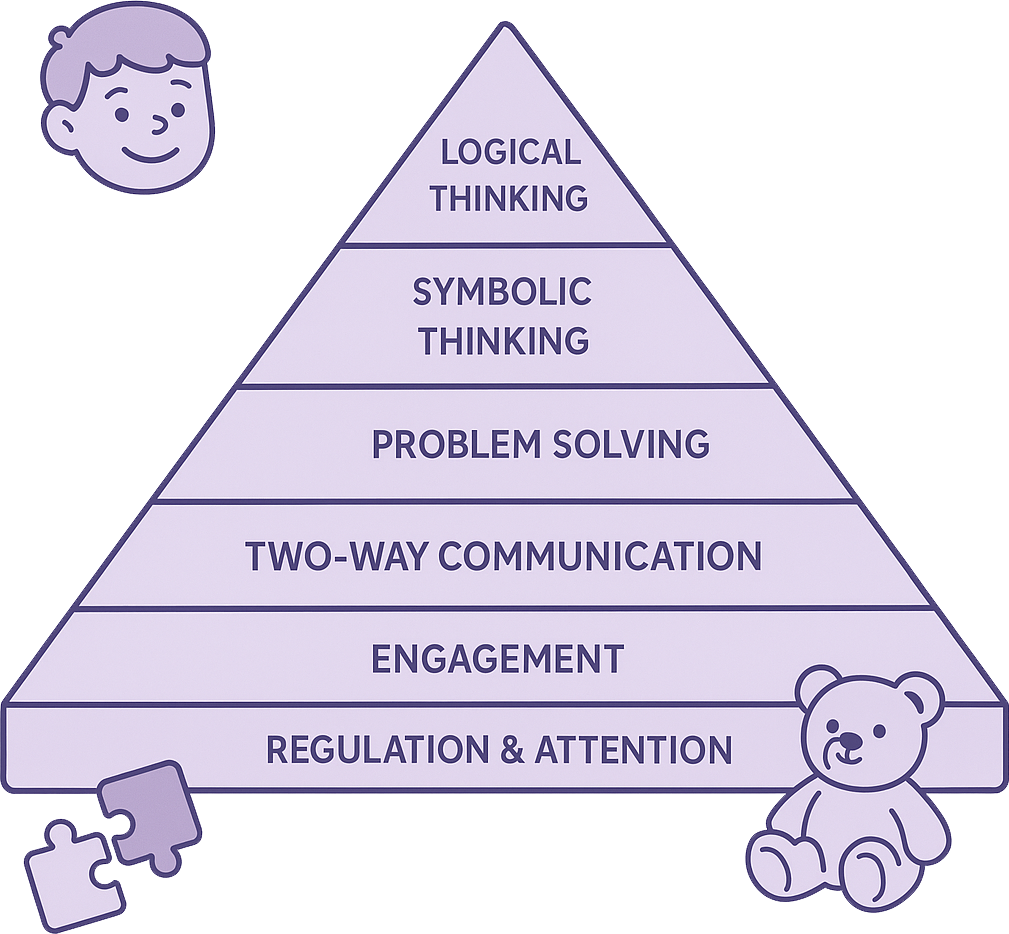
DIR Therapy is a gentle, research-backed approach that helps children with autism and other developmental challenges grow in the areas that matter most: emotional connection, communication, critical thinking, and social engagement.

Floortime is the hands-on, play-based part of the therapy. During sessions, we literally and figuratively get on the floor with the child entering their world, following their lead, and using emotionally meaningful moments to build new skills. It may look like play, but every activity is intentionally designed to work on key developmental goals.
Parents are a core part of the process. We don’t just work with the child, we teach caregivers how to continue the work at home, in the bath, at the park, or over dinner. Over time, this approach strengthens the brain’s capacity to engage, think, and connect and helps children carry their new skills into real-world settings.
ABA is a well-established therapy that focuses on behavior and uses reinforcement to guide change. DIR Floortime takes a different approach. It looks beneath the behavior to understand what a child may be feeling or needing. If a child is biting, for example, we ask why. Are they overwhelmed? Seeking sensory input?
DIR Floortime supports growth by building emotional connection, communication, and self-regulation. Both therapies are valid and can be effective. At Building Butterflies, we focus on DIR Floortime for families looking for a relationship-based and developmental model.




DIR/Floortime changes the how — not just the what. When children feel understood and supported, they begin to engage more, try more, and grow more. The therapy taps into their natural desire for connection and helps rewire their brain — building real, sustainable progress that goes beyond surface-level behaviors.
Dr. Stanley Greenspan, the founder of DIR Floortime Therapy, was a pioneer in child development. With deep compassion and insight, he reshaped the way we understand and support children with developmental challenges. In this video, Dr. Greenspan shares the heart behind DIR Floortime—focusing not just on behavior, but on building real human connection, emotional growth, and lifelong learning.
Rebecca is a certified DIR Floortime specialist with a Master’s degree in Special Education and over 18 years of experience working in both educational and clinical settings. A passionate advocate for the DIR model, she has dedicated her career to supporting children with developmental differences and their families.
Rebecca’s formal journey with DIR began in 2008 after witnessing its transformative impact on her students. In 2009, she began training with leading pioneers in the field, including Stanley Greenspan, Serena Wieder, and Jake Greenspan. She later completed her certification through Profectum Foundation and continued advanced mentorship with renowned DIR faculty such as Rosemary White, OTR/L; Sima Gerber, PhD, CCC-SLP; and Dianne Selinger, PhD.
Driven by a commitment to understanding the whole child, Rebecca has pursued extensive training across all domains of development, including occupational, physical, speech, and mental health. She continues to expand her expertise and has earned multiple advanced DIR certifications.
In 2014, Rebecca founded The Bright Star Center for Pediatric Therapy, where she brought her integrative, relationship-based approach to life. In addition to her clinical work, she serves as a trainer and consultant in both general education and special education settings. She leads workshops and hands-on training sessions for educators and therapists, and provides coaching to parents and teachers—helping them better understand each child’s unique profile and thoughtfully adapt environments and curricula to support growth.
Rebecca’s current passion project, Building Butterflies, reflects her vision of creating a comprehensive, high-quality system of care and education for families of children with developmental differences.

Your child holds incredible potential. At Building Butterflies, we use DIR Floortime Therapy to nurture development at the root, not just the surface, helping them connect, communicate, and flourish.
Contact us now to find out if your child can benefit from DIR Floortime Therapy.


©2026 Building Butterflies. All rights reserved.
Website Created By: Summit Group