DIR Floortime in the Classroom: 5 School-Day Examples
DIR Floortime in the classroom targets daily participation. Five examples show how support can look at school.

DIR Floortime in the classroom targets daily participation. Five examples show how support can look at school.
Key Points:
DIR Floortime in the classroom can support communication, relationships, and participation during everyday school activities. A child may enjoy a story but struggle with a crowded reading corner. Another may want to join classmates but need help getting an idea across.
At Building Butterflies, our school-based DIR Floortime support in New Jersey includes classroom observation, one-to-one therapy, and teacher coaching. These services let us work with educators in the setting where school challenges happen.
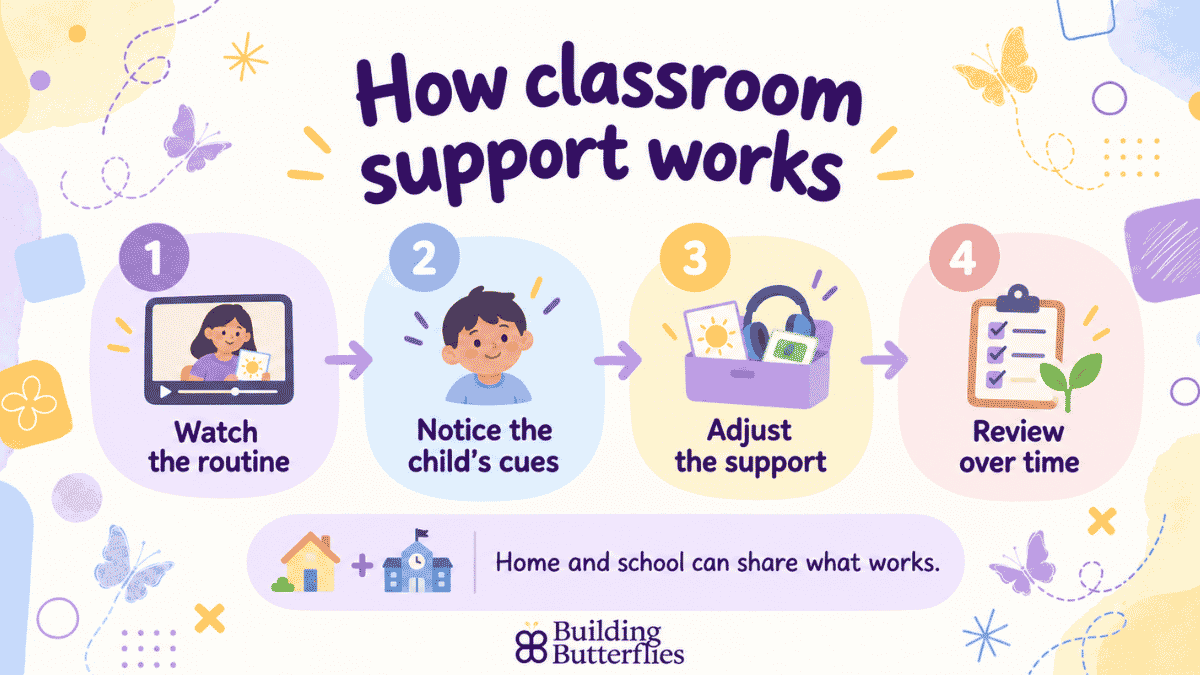
A school Floortime therapist observes how a child responds to activities, joins the child’s interests, and encourages back-and-forth interaction. Support considers the child’s development, communication, and responses to sound, movement, and other sensations.
School support can include child-led Floortime and DIR-informed strategies during adult-led activities. A teacher-led lesson has different demands from free play. The DIR educational framework includes spontaneous interaction, shared problem-solving, and activities that address sensory and movement needs.
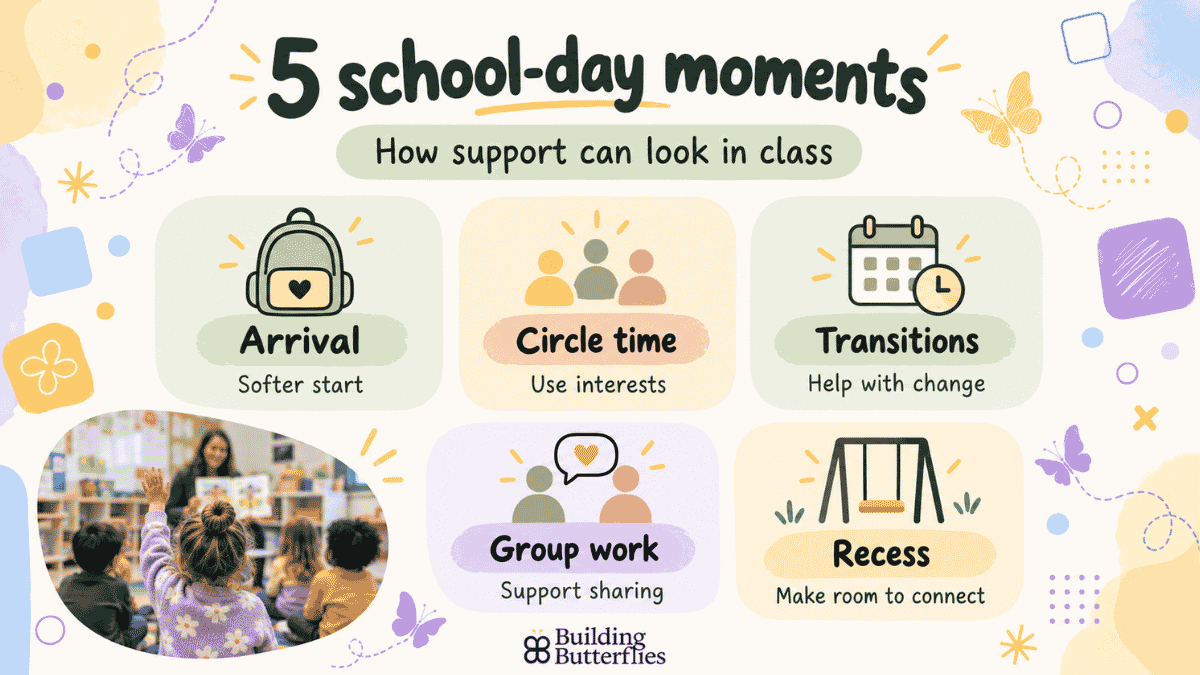
The five examples below illustrate possible approaches. Each child’s needs and school plan shape the support.
Arrival can show what a child needs before formal teaching begins. Hallway noise, separation from a caregiver, and several instructions at once may affect how the morning starts.
A therapist might watch which part of arrival causes difficulty and how the child communicates discomfort. Support could include a quieter greeting, more response time, or a connection through a familiar interest.
Example: A child pauses at the doorway while classmates rush past. An adult gives them space, acknowledges the noise, and offers a choice between two familiar starting activities.
The focus is on understanding the child’s response and helping them enter the routine. Individual differences in autism help explain why the same classroom can feel different to each child.
Circle time asks children to follow someone else’s topic, share space, and respond within a group. A therapist can observe which parts of that experience support or interrupt participation.
A child might follow a story while standing near the group, holding a familiar object, or responding through gestures. Support should account for the child’s sensory and learning differences.
Example: A child loves animals but rarely responds during story time. During a pause, the adult offers animal pictures that let the child choose which character to talk about.
Our teacher coaching helps educators bring DIR strategies into classroom routines. That collaboration connects individual support with the lesson already taking place.
Moving between activities can involve several challenges at once. A child may need to stop something enjoyable, understand the next task, and move through a noisy space.
A therapist can examine where the difficulty begins. The adult’s response might include acknowledging disappointment, showing what comes next, or allowing time to finish a small part of the activity.
Example: A child becomes upset when block play ends. The adult recognizes that the tower feels unfinished and offers a photo of the creation before cleanup. Together, they identify where building can continue later.
The goal is to support communication and participation during the change. A child’s request for help, pause, or explanation gives adults information they can respond to.
Group work creates opportunities to share ideas, solve problems, and respond to another child. A therapist can help make those exchanges accessible while allowing classmates to interact directly.
Example: Two children want different roofs for a model house. The adult acknowledges both ideas and offers materials for trying each design. The shared problem gives the children a reason to exchange choices and reactions.
Speech is one way to participate. Gestures, pictures, and speech devices can also support communication. A child’s communication system should remain available throughout the day. asha.org
We coordinate school support with speech-language and occupational therapy when those services are part of a child’s care. Our focus on back-and-forth communication includes expressing preferences, responding to others, and sharing ideas.
Recess gives children more choice about activities and social contact. A therapist can observe what draws a child’s interest, whether they want company, and which conditions make participation difficult.
Support might involve joining a chosen game, helping a child communicate an invitation, or recognizing a request for space.
Example: A child enjoys rolling a ball down a slope. Another child watches nearby. With both children’s interest, the adult helps them arrange a back-and-forth game and gradually gives them more room to direct it.
Quiet or solitary play can also be a child’s choice. Recess support should respect that choice while keeping opportunities for connection available.
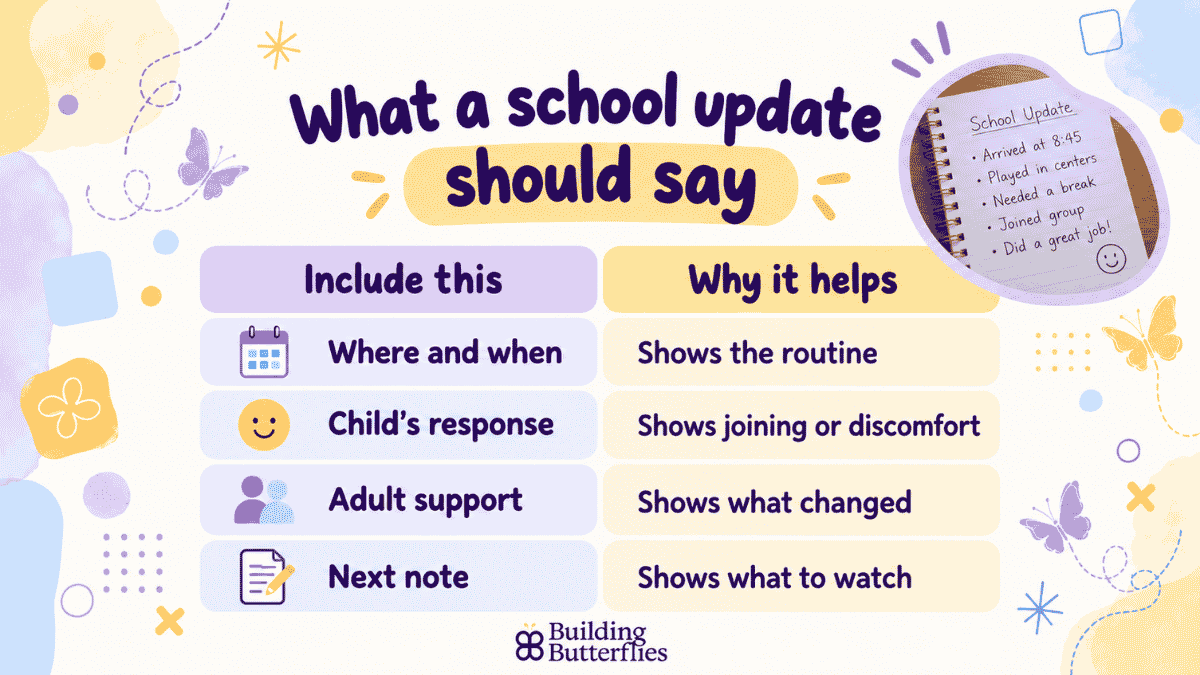
A helpful update explains what happened and how much support the child needed. Broad comments such as “great participation” leave parents with little information about the school day.
A brief record can include:
For example: “During a shared art activity, your child pointed to the blue paint and passed it to a classmate after one adult reminder.”
That description gives the team something specific to compare over time. Several observations provide more context than one successful or difficult day.
Floortime does not require sitting on the floor. The approach can happen at a table, outdoors, or in other everyday settings. The central features are the child’s interests, relationships, and back-and-forth interaction. ICDL describes Floortime across everyday settings, including playgrounds.
The schedule depends on the child’s needs, goals, and school arrangements. Direct sessions and teacher consultation may serve different purposes. Parents, educators, and the provider should agree on the purpose of each visit and how they will review the plan.
Private therapy does not automatically become part of an Individualized Education Program, or IEP. The IEP team determines educational services through the school planning process. New Jersey IEP requirements center the child’s individual educational needs. Our explanation of requesting DIR Floortime in an IEP covers that separate process.
School routines can show where a child needs help and what supports participation. Specific examples from class give parents, teachers, and therapists a shared starting point for planning support.
At Building Butterflies, we work with educators to bring relationship-based DIR Floortime support into New Jersey schools. Our team can talk with you about your child’s school needs and available service options.

Your child holds incredible potential. At Building Butterflies, we use DIR Floortime Therapy to nurture development at the root, not just the surface, helping them connect, communicate, and flourish.
Contact us now to find out if your child can benefit from DIR Floortime Therapy.


©2026 Building Butterflies. All rights reserved.
Website Created By: Summit Group
