Too Young for Therapy? Starting DIR Floortime Before Age 3 in New Jersey
DIR Floortime before age 3 uses familiar play to support regulation, shared attention, and communication. See what goals and progress can look like.

DIR Floortime before age 3 uses familiar play to support regulation, shared attention, and communication. See what goals and progress can look like.
Key Points:
A child does not need to reach preschool age, speak in sentences, or sit through a formal lesson to begin DIR Floortime before age 3. Sessions for infants and toddlers use movement, sounds, familiar toys, facial expressions, and daily routines to support regulation and early back-and-forth interaction.
At Building Butterflies, we provide DIR Floortime services for young children through in-home and clinic-based options across New Jersey. We often meet toddlers who stay pressed against a caregiver, watch us from a distance, or leave when a new adult joins. Those responses already tell us where connection can begin.
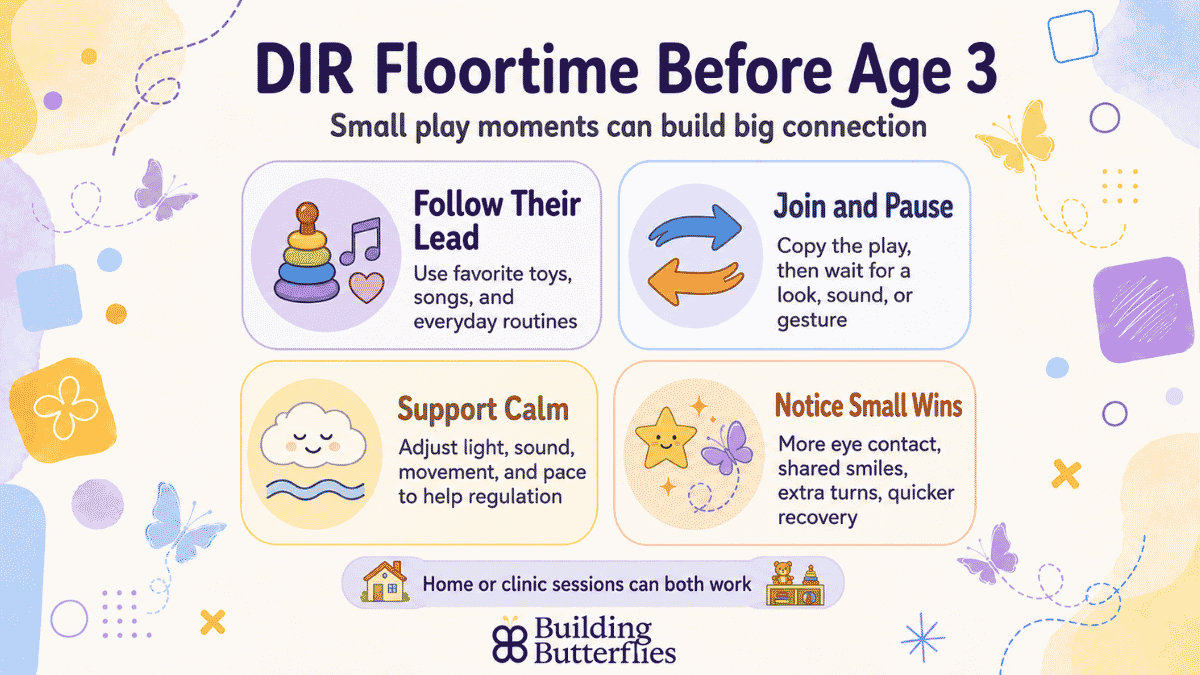
Parents often ask if a toddler can participate in therapy before they learn to sit still or follow directions. The simple answer is yes.
DIR Floortime meets young children where they are emotionally and physically, without expecting skills tied to a calendar age. Very young children already communicate through movement, facial expressions, sounds, reaching, and body language.
Spoken language and table tasks are never required to start. When a child focuses on a spinning toy, a favorite song, or a soft blanket, that interest creates a natural opening for connection. Starting DIR Floortime before age 3 helps caregivers learn how to read those subtle cues during daily routines at home.
A pilot randomized trial showed greater developmental gains when parent-led home DIR Floortime was added to routine care for children with autism. Something we notice often in our work: parents sometimes worry a toddler who clings to them is refusing therapy, but we treat that closeness as the safest starting point for connection.
At first glance, a session might look like simple play on the rug. Beneath that play, a practitioner observes how your child processes sensory input, stays regulated, and responds to people. During our sessions, we focus on subtle cues like eye gaze, body position, and vocal tones.
We use DIR Floortime for infants and toddlers to turn everyday play into moments of communication and connection. A typical session follows a clear rhythm:
This structured flow makes DIR Floortime for toddlers feel natural and unhurried for your family. It helps young children build communication skills without pressure.

Two toddlers of the exact same age often start therapy with completely different needs. Goals in DIR Floortime from ages 18 months to 3 years center on emotional connection, shared attention, and self-regulation rather than academic tasks.
Early goals often include:
Progress in early development rarely shows up as immediate spoken words. Instead, you might see your child glance back when a nursery rhyme stops, bring a favorite item to show you, or settle down faster after a meltdown.
Families we work with often notice the first changes in ordinary moments. One family noticed their child started waiting by the couch for a bouncing game to continue, then used a joyful squeak to ask for another turn. That simple gesture showed a real leap in intentional communication.
Remember to evaluate progress over several weeks rather than judging a single afternoon. Sleep changes, teething, hunger, and sensory load can easily alter how your child interacts on any given day.
A toddler does not need to reach every milestone before you ask about developmental support. Our team can listen to what you see at home, explain how sessions work for very young children, and help you choose between an in-home or clinic setting. Contact Building Butterflies today to discuss the best next step for your family.
Understanding developmental support options across New Jersey can feel confusing for new parents. The early intervention program in NJ is a state-coordinated system that serves infants and toddlers from birth to age three with developmental delays or disabilities.
Here is how the two options compare:
A referral to the state system does not automatically guarantee DIR Floortime in your child's plan. Asking individual providers about their specific approach helps make your options easier to understand.

The early weeks of therapy focus heavily on safety and trust. Your toddler might spend initial DIR Floortime sessions moving around the room, watching the therapist from across the mat, or returning to your lap. That behavior is a normal part of getting comfortable.
During early sessions, you can expect a thoughtful process:
We also respect your family's daily schedule. Therapy for a two-year-old should never crowd out naptime, family meals, or unstructured play. Some toddlers need several meetings before they step away from a parent or include a new face in play. In our sessions, we view that initial observation period as an essential phase of building trust, not lost time.
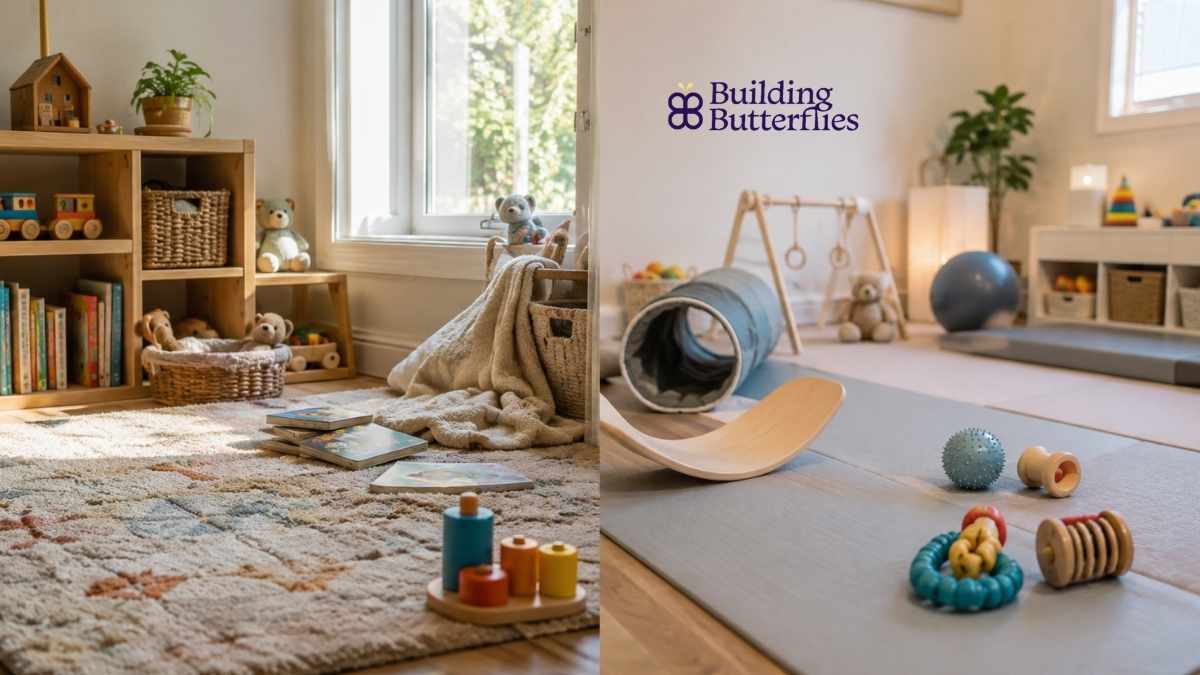
Our New Jersey team provides DIR Floortime through flexible in-home and clinic-based options across Bergen, Essex, Morris, Ocean, Monmouth, Middlesex, and Hudson Counties. In-home visits allow us to support your child surrounded by familiar toys and daily routines. Meanwhile, our clinic spaces offer a dedicated setting designed to reduce extra distractions.
Families across the state frequently tell us how much it means to have a therapist who celebrates every small step:
Having a practitioner who recognizes a brief glance, a paused movement, or a shared smile as meaningful progress makes all the difference for a growing toddler. Our team focuses on celebrating those subtle moments with you every step of the way.
Yes. DIR Floortime integrates well with speech and occupational therapy. When providers collaborate, they align on sensory needs and communication goals. Parents often tell us that combining approaches helps their child carry over regulation tools smoothly across different settings.
Yes, when appropriate. We often invite siblings into play once a child feels regulated, as brothers and sisters make fantastic play partners for turn-taking. If extra activity causes sensory overload, we start with just the parent and child first.
Ask about the therapist's specific DIR training, experience with children under three, and how parents participate in sessions. You should also ask how they handle moments when a toddler walks away or becomes upset, ensuring their approach matches your family's needs.
Your child's gestures, sounds, movements, and favorite play routines offer rich opportunities to build communication today. Beginning DIR Floortime before age 3 helps turn those everyday interactions into strong developmental foundations.
At Building Butterflies, we provide child-led therapy through in-home and clinic-based services for families across New Jersey. You can reach our team by calling (973) 899-1816, emailing info@buildingbutterflies.com, or completing our contact form.
We will discuss your child's development, explain available session settings, check local scheduling, and guide you through insurance verification so your family can proceed with confidence.

Your child holds incredible potential. At Building Butterflies, we use DIR Floortime Therapy to nurture development at the root, not just the surface, helping them connect, communicate, and flourish.
Contact us now to find out if your child can benefit from DIR Floortime Therapy.


©2026 Building Butterflies. All rights reserved.
Website Created By: Summit Group
