DIR Floortime for Toddlers in New Jersey: How Therapy Goals Shift as Your Child Grows
DIR Floortime for toddlers in New Jersey focuses on regulation, shared attention, and play-based goals. See how therapy shifts as children grow.

DIR Floortime for toddlers in New Jersey focuses on regulation, shared attention, and play-based goals. See how therapy shifts as children grow.
Key Points:
What does therapy look like when a child is only two? Many parents ask this when their little one shows developmental differences. When exploring options for DIR Floortime toddlers in New Jersey, families often look at basic regulation. They focus on shared attention.
These early steps build a base for later learning. DIR Floortime therapy goals change as your child grows. A two-year-old may need help staying calm during peek-a-boo. A six-year-old may practice pretend play or flexible thinking. Milestones grow right alongside your child.

Many professionals use the Developmental, Individual-Differences, Relationship-Based (DIR) Floortime method with young children from birth to age five. Early support helps you read your child’s signals in daily routines. You learn to join their play. You learn to support regulation.
Older children can still benefit from this DIR approach. The therapy matches your child's developmental level instead of their calendar age. Research suggests this play-based method is most common for children aged 0 to 5. However, it can apply far beyond that range.
DIR Floortime for toddlers in New Jersey usually starts with the basics. A toddler has to feel regulated before learning feels possible. Social-emotional development often starts with shared attention before conversation. Engagement comes before formal tasks.
Toddler sessions may use simple play, such as:
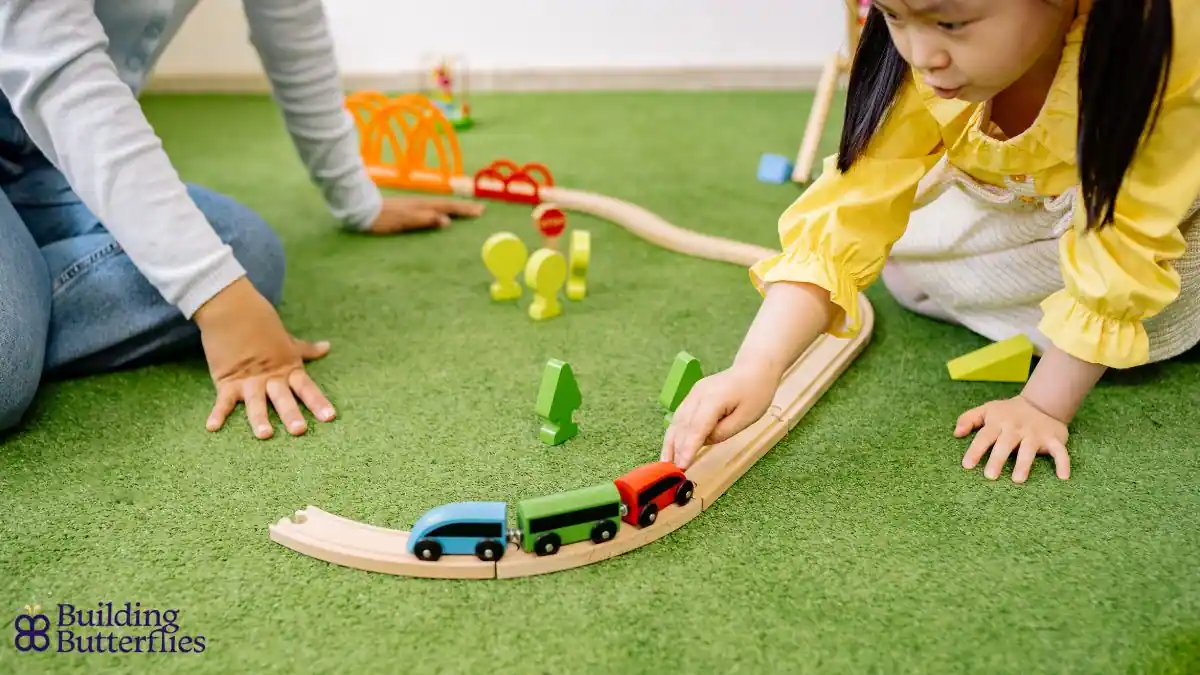
Let's look at a real session example for a DIR Floortime 2-year-old New Jersey toddler. A child rolls a toy car away from the therapist. The therapist does not take the car away. Instead, the adult joins the play. The therapist waits. They copy the child's action. Then, the adult adds one small challenge. They watch closely for a look or a sound.
Success means connection. It means shared interaction. It does not mean a perfect performance. The session looks simple from the outside. Still, the therapist tracks shared attention, sensory needs, and communication the entire time.
Conversations about DIR Floortime early intervention in New Jersey often happen when a child is under age 3. New Jersey families with developmental concerns about children under 3 can seek help through the New Jersey Early Intervention System.
DIR Floortime may be discussed as part of a child’s developmental support plan when it matches the child’s needs. It should not be promised as part of every plan.
What happens next? Around age three, families often transition to preschool special education services. These services run through your local school district.
Goals should follow the child’s developmental level, not age alone. Two children can be the same age and need different starting points. Experts call these Functional Emotional Developmental Capacities. DIR Floortime looks at how a child regulates, connects, communicates, and thinks.
The same child-led approach stays in place. The goal changes because the child’s nervous system is changing. Their language and social world change too.
Your child needs goals that match their current development. At Building Butterflies, we look at how your child regulates. We check how they connect and communicate. This happens before any goals are set. Contact us today to ask what therapy goals may look like for your child’s age.

As children grow past the toddler years, their social world expands. Understanding Floortime therapy age differences in NJ helps parents see how the play changes. Preschool goals focus heavily on expanding pretend play. They focus on solving simple problems with an adult.
A plan for a Floortime therapy school age child in NJ handles different challenges. School-based support may address school routines. They may target peer play or frustration tolerance. For example, a DIR Floortime 6 year old NJ session may look less like sensory play alone. It may include story-based play, board games, classroom themes, or social problem-solving.
The therapist still follows the child’s lead. The challenge just becomes more layered. A child who once worked on staying engaged with a toy car may later work on handling a game rule change without falling apart.
Where your child receives therapy changes the daily goals. Setting age appropriate Floortime goals New Jersey parents can expect means looking at where the child spends their day.
These services are available across New Jersey. Families in Montvale, Lakewood, Toms River, Hoboken, Edison, Hackensack, Newark, and Monmouth County may need different setting combinations. The choice depends on your schedule and school needs.
The therapy does not always require a formal diagnosis to begin. Many parents seek out developmental support when they first notice communication delays or regulation struggles. A licensed professional can review your child's unique needs and recommend appropriate services.
The hours of DIR Floortime children need each week will vary based on their own unique developmental profile and family schedule. Some plans combine direct sessions with active parent coaching. Your therapy provider will help determine the right amount of practice for daily routines.
During a session for DIR Floortime, parents should watch how the therapist reads and responds to cues. A strong session always centers on building shared attention through play. The adult should help the child stay calm before introducing new challenges.
A child’s Floortime goals should grow right along with their developmental stage. Toddler goals usually center on regulation, while older children work on social reasoning and richer play.
At Building Butterflies, we support New Jersey families through in-home, school-based, and clinic-based DIR Floortime. Our team serves areas including Montvale, Lakewood, Toms River, Hoboken, Edison, Hackensack, Newark, and Monmouth County. Call (973)-899-1816, email info@buildingbutterflies.com, or fill out the contact form today to learn more about goals for your child.

Your child holds incredible potential. At Building Butterflies, we use DIR Floortime Therapy to nurture development at the root, not just the surface, helping them connect, communicate, and flourish.
Contact us now to find out if your child can benefit from DIR Floortime Therapy.


©2026 Building Butterflies. All rights reserved.
Website Created By: Summit Group
