Clinic or In-Home DIR Floortime? What Actually Changes for Your Child
Clinic vs in-home DIR Floortime changes focus, caregiver coaching, skill carryover, and travel. Compare both settings before choosing the best fit.

Clinic vs in-home DIR Floortime changes focus, caregiver coaching, skill carryover, and travel. Compare both settings before choosing the best fit.
Key Points:
Clinic or In-Home DIR Floortime therapy uses the exact same child-led, relationship-focused model, but picking between settings changes what a therapist observes, which distractions enter the play space, how caregivers participate, and how sessions fit into your weekly routine. Deciding where therapy happens comes down to understanding how your child learns best right now.
Every family balances different needs when exploring developmental support for children with autism or developmental differences. Choosing a location depends on four key factors: skill carryover, distraction load, caregiver participation, and travel requirements.
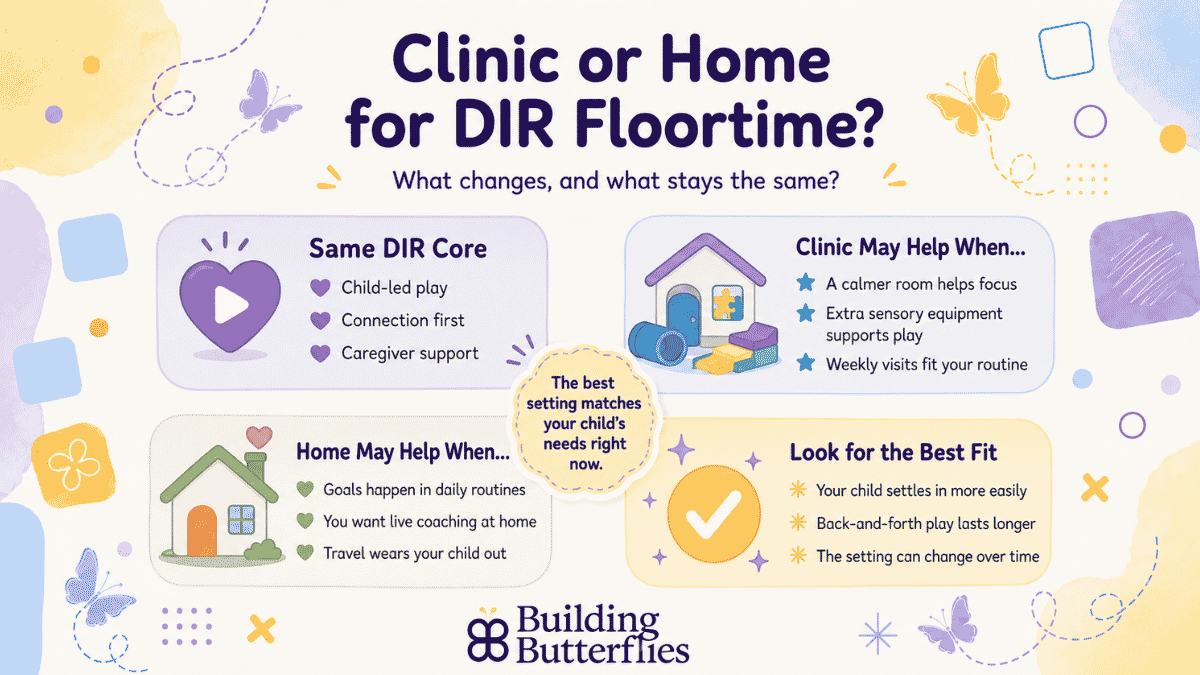
Both settings follow the core principles of Developmental, Individual-Differences, Relationship-Based therapy. The core model never changes based on the room you enter.
Our clinicians focus on your child's unique interests, sensory processing profile, and current developmental level during every interaction. We look for subtle cues, join self-directed activities, and help build longer communication loops through warm interaction.
Core elements present in every session:
Our team applies these exact principles whether we meet at our Montvale clinic or inside your family home. While the physical space changes, your child's emotional growth remains the central focus. We view caregivers as essential partners across every setting.
Choosing center-based DIR Floortime in New Jersey provides a structured environment crafted specifically for therapeutic play. In a clinic, our therapists regulate lighting, noise, and the number of available toys to help your child maintain focus. This organized space removes many household interruptions, making it easier to build shared attention.
A clinic setting often benefits a child who:
Our Montvale clinic supports families across Bergen County, including Park Ridge, Woodcliff Lake, Westwood, and Ridgewood. The clinic space offers specialized play equipment designed to encourage movement and interaction.
Some children spend their first clinic visits exploring the room before inviting another person into their play. Our clinicians respect that adjustment period and give children the time they need to feel safe.

Choosing home sessions allows our clinicians to observe your child inside their natural daily environment. The home-based DIR Floortime benefits center on real-life context. We can see how your child handles daily routines, reacts to household sounds, interacts with siblings, or responds when a favorite toy is out of reach.
Home visits place you directly beside the interaction. You can practice DIR Floortime coaching strategies right as everyday moments happen, with immediate support from your clinician.
While managing household activity takes effort, seeing therapy strategies applied in your living room makes daily practice feel more manageable. Research suggests that parent-led home interventions can support developmental progress when integrated into daily family life.
Families sometimes expect home sessions to require a quiet room and a perfect routine. Our work often begins with the home exactly as it is, including background noise and sibling interruptions your child experiences every day.
Comparing settings helps clarify which location aligns with your family's current capacity. A DIR Floortime setting comparison in NJ highlights how environment shapes daily progress.
The exact same environmental feature can help one child while creating a challenge for another. A busy home environment might distract one child, yet give another child valuable practice regulating through natural family sounds. Travelling to a clinic may tire one child, while helping another gain confidence in new environments.

When choosing a DIR Floortime location, you are selecting the framework that best supports your child's current regulation and engagement goals. The best DIR Floortime setting in NJ is simply the one that fits your family right now.
A clinic setting may fit best if:
An in-home setting may fit best if:
Your initial DIR Floortime setting choice does not bind your family forever. As your child's regulation improves or your family schedule changes, we can adjust the setting to match new goals.
Our team evaluates your child's regulation style, sensory needs, daily routines, and family logistics during intake. A quick conversation with us helps clarify whether our Montvale clinic or in-home visits across Bergen County fit your family best. Contact Building Butterflies today to explore which setting supports your child's growth.
When therapy occurs in the right setting, children feel understood and secure. Parents often tell us their child began opening up the moment they felt comfortable in the space. Feeling like true partners in therapy helps parents feel confident using relationship-based strategies outside of scheduled session times.
Key indicators that a setting is working well for your child:

No separate room is needed. In-home sessions work well in living rooms, bedrooms, or play spaces where your child already spends time. We adjust minor distractions as needed, but your home does not need to look like a clinic.
Siblings can join when their presence supports your child's goals. We often start one on one, then invite siblings in to practice turn taking and shared play. One parent recently noticed her sons playing together constructively for the first time after we guided sibling interaction during home visits.
Insurance coverage often varies by policy, service code, and setting. Some plans cover clinic visits while restricting home services, or vice versa. We verify your insurance benefits directly and explain your coverage options clearly before sessions begin.
Both clinic and home sessions rely on the same relationship-centered DIR foundation. Choosing between them comes down to your child's sensory needs and learning style, along with your family's daily schedule.
At Building Butterflies, our team provides clinic-based DIR Floortime at our Montvale location and in-home support across Bergen County communities, including Park Ridge, Ramsey, Mahwah, Paramus, Hackensack, Ridgewood, and Teaneck.
Call (973) 899-1816, email info@buildingbutterflies.com, or complete our online contact form. We will reach out to discuss your child's unique needs, verify your insurance coverage, and help you select the setting where your child can grow.

Your child holds incredible potential. At Building Butterflies, we use DIR Floortime Therapy to nurture development at the root, not just the surface, helping them connect, communicate, and flourish.
Contact us now to find out if your child can benefit from DIR Floortime Therapy.


©2026 Building Butterflies. All rights reserved.
Website Created By: Summit Group
