How to Start DIR Floortime Therapy in New Jersey From Intake to First Session
How to start DIR Floortime therapy in New Jersey begins with intake, records, insurance, and therapist fit. See each step before the first session.

How to start DIR Floortime therapy in New Jersey begins with intake, records, insurance, and therapist fit. See each step before the first session.
Key Points:
Learning how to start DIR Floortime therapy in New Jersey begins with a DIR Floortime intake call, a review of your child’s developmental history, insurance verification, therapist matching, and a first session built around observation and connection. This approach focuses on relationships to support self-regulation, communication, and shared social problem-solving.

The Floortime therapy intake process for New Jersey families begins with a simple, informative exchange where the intake team collects basic details. They want to see if the program aligns with your family's routine. You should feel ready to talk about your child's age, communication style, sensory needs, and current school placement.
Having your paperwork organized can speed up the process. Bring these items to your intake step:
This initial call also covers location options, waitlist status, and scheduling hours.
DIR Floortime focuses deeply on a child's unique developmental level, sensory profile, processing differences, and daily relationships. Your personal observations as a parent carry immense value during this stage.
New Jersey families with infants or toddlers under three years old often bring records from the New Jersey Early Intervention System, or NJEIS. For older children, helpful records include school IEP documents, Child Study Team notes, or speech and occupational therapy reports.
A missing report should not stop you from asking questions. It may only change what the provider can verify first. You can start the conversation before every document is ready.

Where does your child feel most comfortable and regulated? New Jersey families often choose a therapy setting based on commute times, school schedules, and family routines.
Location matters when you plan weekly sessions. Families in North Jersey often use the Garden State Parkway, Route 17, Route 4, or Interstate 80. Those in Central Jersey or near the Shore often travel near Route 9, Route 18, or the New Jersey Turnpike.
Consider these logistics to find a good option for getting started with Floortime therapy for NJ families:
At Building Butterflies, we can talk through your child’s routines, location options, therapist compatibility, and coverage questions before sessions begin. Our team supports families across New Jersey through home, school, clinic, and community-based DIR Floortime options. Share your child’s current needs, your town, and your schedule so we can help you see what opening may fit.
Understanding your health benefits avoids unexpected costs down the road. New Jersey maintains specific insurance rules for autism and developmental disability services, but your coverage still depends on your plan, medical necessity, and billing codes. Medicaid, fully insured commercial plans, and self-funded employer plans all follow different guidelines.
Many parents express anxiety about hidden fees when starting Floortime therapy for New Jersey autism support. A clear verification process clears up this confusion early.
Ask these specific questions during verification:

A high-quality provider matches your child with a practitioner based on personality, skills, and sensory needs, not just open calendar slots. A child who avoids new adults needs a therapist who uses a slow, gentle warm-up. Meanwhile, a child who seeks constant movement needs someone ready for active play.
Children with autism communicate in diverse ways. Even without spoken words, a therapist can build communication through gestures, vocal sounds, eye gaze, or movement.
Here is how to enroll in DIR Floortime in NJ after the provider confirms compatibility, paperwork, and scheduling. Ask the provider these questions before saying yes:
The initial visit should never feel like a rigid exam that your child can fail. Instead, the therapist focuses entirely on building comfort and trust. They look at how your child enters the room, interacts with toys, seeks help, or recovers from frustration.
This visit marks the Floortime therapy first steps for NJ families to experience relationship-based care. During early DIR Floortime sessions, the therapist follows your child's lead and joins their play rather than forcing a strict agenda. This approach helps create back-and-forth interactions called circles of communication.
Prepare for the first session with these simple steps:
No. Many children receive DIR Floortime while continuing speech therapy, occupational therapy, or school support. Share these reports during intake so goals fit your child's full support plan.
Yes. This approach works directly with gestures, sounds, movement, eye gaze, and emotional cues. Spoken words are not the only sign of communication. The primary goal remains building human connection and interaction.
Both can join if available, especially since caregivers observe different routines across bedtime or community outings. However, one caregiver can start the process by sharing records, scheduling needs, and insurance details.
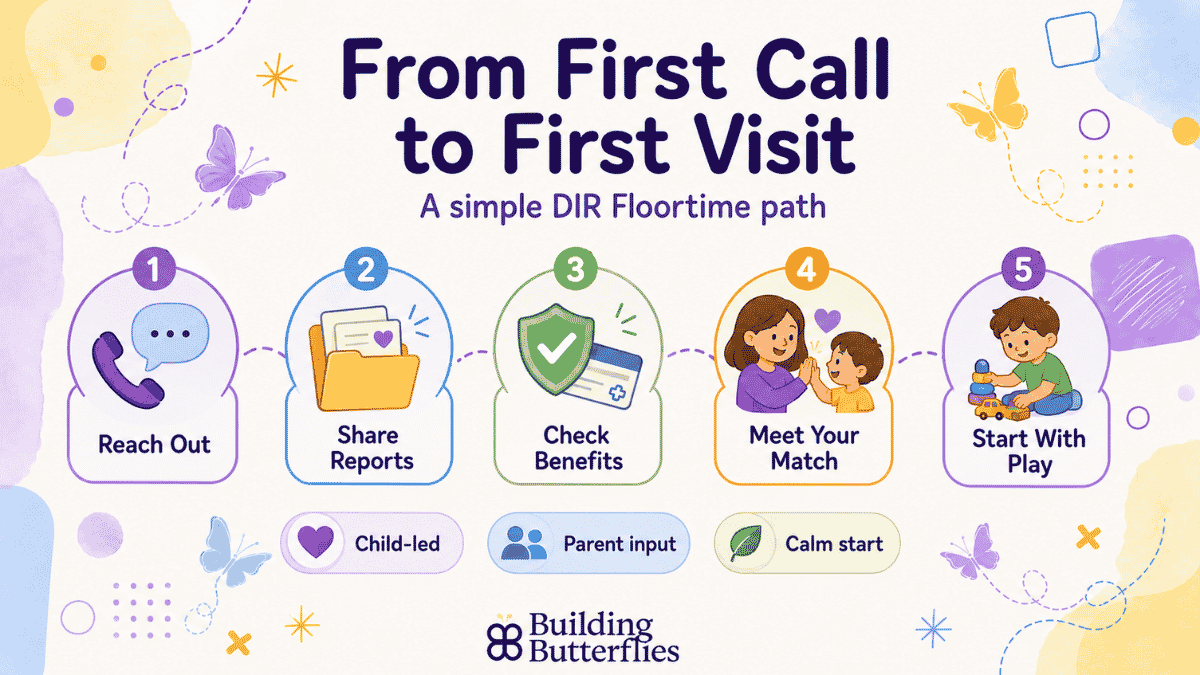
Starting therapy feels more manageable when you know the order: intake, records, setting, coverage, therapist match, and first session. A good first step should leave you with fewer unknowns and a clearer idea of what support could look like for your child.
At Building Butterflies, we support New Jersey families through DIR Floortime services in home, school, clinic, and community settings across areas such as Lakewood, Toms River, Hoboken, Edison, Hackensack, Newark, and Monmouth County. Call (973) 899-1816 or fill out the contact form with your child’s details, insurance information, and town. Our intake team will review availability, check coverage, and explain what happens before your first session.

Your child holds incredible potential. At Building Butterflies, we use DIR Floortime Therapy to nurture development at the root, not just the surface, helping them connect, communicate, and flourish.
Contact us now to find out if your child can benefit from DIR Floortime Therapy.


©2026 Building Butterflies. All rights reserved.
Website Created By: Summit Group
