How Much Does DIR Floortime Therapy Cost in New Jersey?
DIR Floortime therapy costs in New Jersey vary by provider. Written quotes help compare fees and payment options.

DIR Floortime therapy costs in New Jersey vary by provider. Written quotes help compare fees and payment options.
Key Points:
DIR Floortime therapy cost in New Jersey depends on the provider’s fee, visit length, recommended schedule, and insurance coverage. A written estimate for your child’s care gives you a starting point. The provider’s full charge may differ from the amount your family owes after insurance.
One appointment each week and several weekly appointments can lead to different bills. The quote checklist and four-week example below can help you compare those costs before scheduling care.

A session price needs two details: how long the visit lasts and what the fee includes. A 45-minute appointment and a 60-minute appointment provide different amounts of time, even when both providers call them a “session.”
The following checklist brings the main cost questions together:
At Building Butterflies, we offer in-home DIR Floortime therapy with caregiver participation and clinic-based sessions that also include parent coaching. Families can request pricing for the service they are considering. Neither setting should be assumed to cost less.
We also provide school-based DIR Floortime support, including classroom observation and teacher collaboration. Before arranging private support at school, families should establish who will pay and what agreement covers the service.
A private-pay budget starts with the quoted fee and the planned number of visits:
Four-week cost = fee per visit × visits per week × 4, plus separate charges.
The example below uses a hypothetical $150 fee for a 60-minute visit. It excludes insurance payments, discounts, assessments, coaching, travel, and other fees. These amounts illustrate the calculation; they are not New Jersey averages or Building Butterflies prices.
These schedules are examples, not treatment recommendations. Your child’s treating team should recommend the amount of professional care.
Four weeks also differ from a calendar month. A month with five weekly appointments would cost more than the four-visit example. Your appointment calendar can help you budget for the actual visits scheduled.
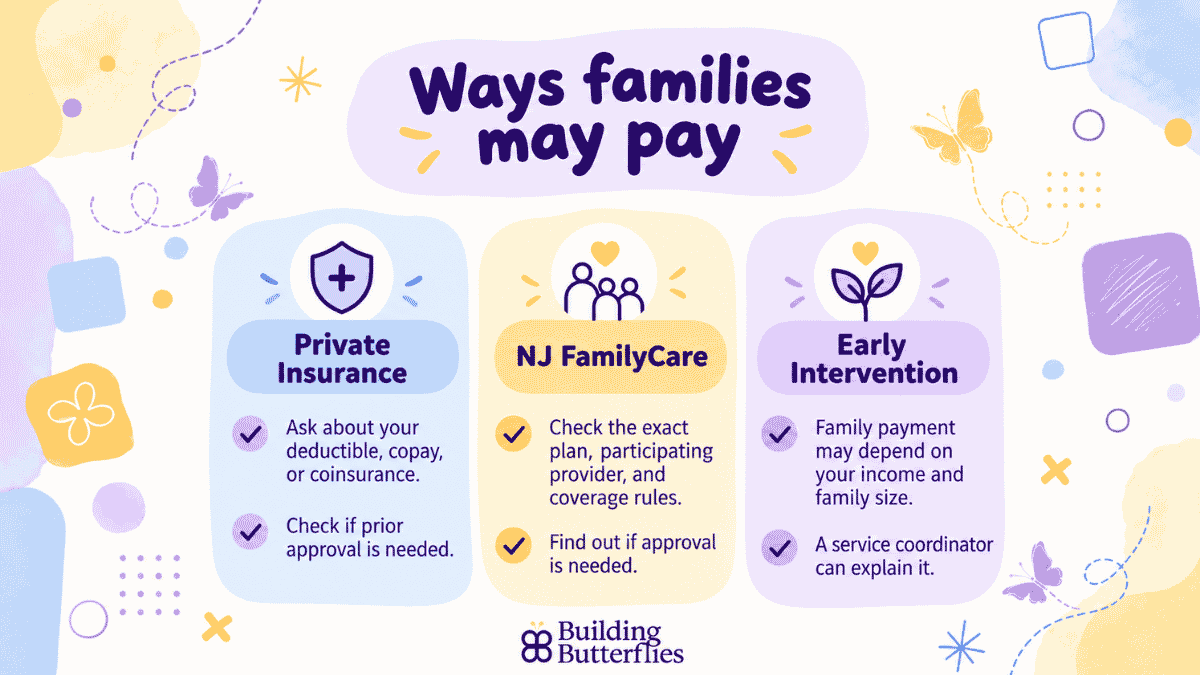
Private insurance, NJ FamilyCare, and New Jersey Early Intervention follow different rules. The right payment questions depend on which coverage or program your child uses.
Your share of a covered service may include:
The health insurance glossary explains these terms. A benefits check should address the exact service, clinician, setting, and plan network. Prior authorization means the insurer reviews care in advance; it does not guarantee payment.
For more detailed questions to bring to the insurer, our New Jersey DIR Floortime insurance article covers billing, provider participation, and approval requirements.
New Jersey Medicaid includes DIR autism services for eligible children with autism. The approved state plan describes assessment, treatment planning, intervention, and provider requirements.
Your child’s NJ FamilyCare plan can identify participating providers and explain required approvals. Our article on NJ FamilyCare coverage for DIR Floortime explains those checks in more detail. Families should verify participation for their exact plan before arranging care.
The New Jersey Early Intervention System serves eligible children until their third birthday. Some services have a family payment based on household income and size. Evaluation, assessment, service coordination, and development or review of the child’s Individualized Family Service Plan are available at public expense. That plan describes the services the child and family will receive.
The Early Intervention family cost policy explains how the state calculates payments. A service coordinator can explain your family’s amount and which program providers can deliver the planned services.
Parent coaching does not automatically lower therapy bills or replace recommended professional sessions. Coaching may have its own fee, so the provider should explain whether it happens within a child’s appointment or receives a separate charge.
At Building Butterflies, we include caregiver participation in our home-based work and offer coaching during clinic-based care. Parents learn ways to join their child’s interests and respond during everyday interactions.
For example, a parent might join a child building a block tower and respond when the child reaches out for another block. This illustrates interaction between appointments. The child’s treating team should decide whether the professional schedule needs to change.
A written quote and an insurance benefits check answer different questions. The provider explains the charges; the insurer explains which benefits and payment rules apply.
Before committing, your family can confirm:
A copy of the estimate, payment policy, and coverage information gives everyone the same details to refer to later.

People who do not have or do not use insurance can generally receive a good faith estimate of expected healthcare charges. Providers usually must supply one upon request or when care is scheduled at least three business days ahead.
An explanation of benefits, or EOB, is an insurer’s statement showing how it processed a claim. The EOB explains the insurer’s payment and your share. It may not reflect payments you already made, so those receipts also belong in your comparison with the provider’s bill.
A folder for written estimates, invoices, receipts, and insurance decisions can help track expenses. A simple list of visit dates, charges, payments, and remaining balances makes it easier to spot missing payments or duplicate charges.
A therapy budget brings together the quoted fees, scheduled visits, separate charges, and expected insurance contribution. Those details help families prepare for costs while keeping care decisions centered on the child’s needs.
At Building Butterflies, we can help with questions about our home, clinic, and school services and insurance benefits. Our contact form includes insurance and ZIP code fields so families can share their details and request information about services and costs.

Your child holds incredible potential. At Building Butterflies, we use DIR Floortime Therapy to nurture development at the root, not just the surface, helping them connect, communicate, and flourish.
Contact us now to find out if your child can benefit from DIR Floortime Therapy.


©2026 Building Butterflies. All rights reserved.
Website Created By: Summit Group
