DIR Floortime and Speech Therapy: Coordinating Care in NJ
DIR Floortime and speech therapy can share goals. A coordinated plan connects support across home and school.

DIR Floortime and speech therapy can share goals. A coordinated plan connects support across home and school.
Key Points:
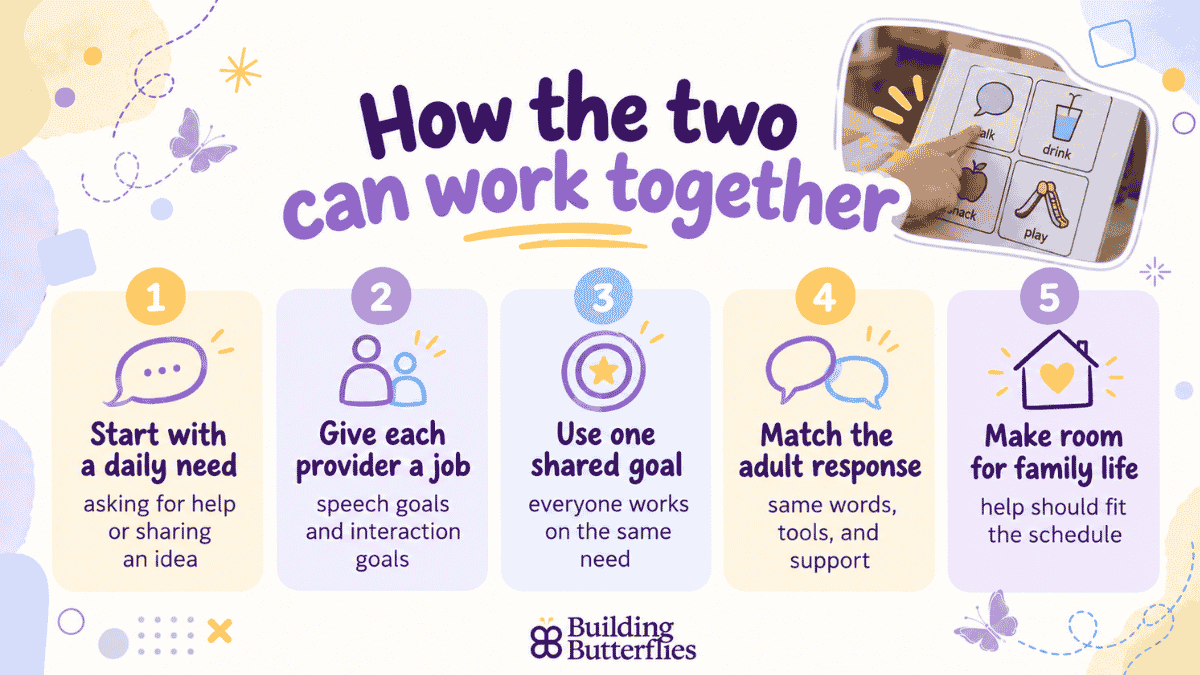
DIR Floortime and speech therapy can work together without replacing your child’s current speech-language care. The connection should serve a daily need, such as sharing an idea, asking for help, or joining a conversation.
A new appointment needs a purpose. Before adding Floortime, the family and providers can identify what it would contribute, how it connects with existing goals, and whether the schedule leaves room for rest and family life.
DIR Floortime focuses on relationships and developmental abilities, including engagement and back-and-forth interaction. A speech-language pathologist, or SLP, assesses and treats communication needs, including speech sounds, understanding language, expressing ideas, and social communication. Speech therapy can also use play and support engagement.
The approaches can address related goals through different professional skills. Possible examples include:
In our Communication & Interaction Therapy, we follow children’s interests and use shared activities to support interaction. Our explanation of communication skills in DIR Floortime covers that developmental focus in more detail.
A coordinated plan gives each professional a defined role and helps adults understand how to support the child between appointments. ASHA includes collaboration with families and other professionals among an SLP’s responsibilities.
A planning conversation can cover four points:
For example, a child drawing a bus wants an adult to add wheels. The SLP might work on how the child expresses that request. The Floortime practitioner might join the drawing and help the pair develop the picture together.
Both providers could note whether the child starts the exchange, how they communicate, and how much help they need. Those observations give the team something specific to compare.
Through our school-based DIR Floortime support, we collaborate with educators and work alongside speech-language support. That school connection gives families a way to bring classroom participation into the conversation.
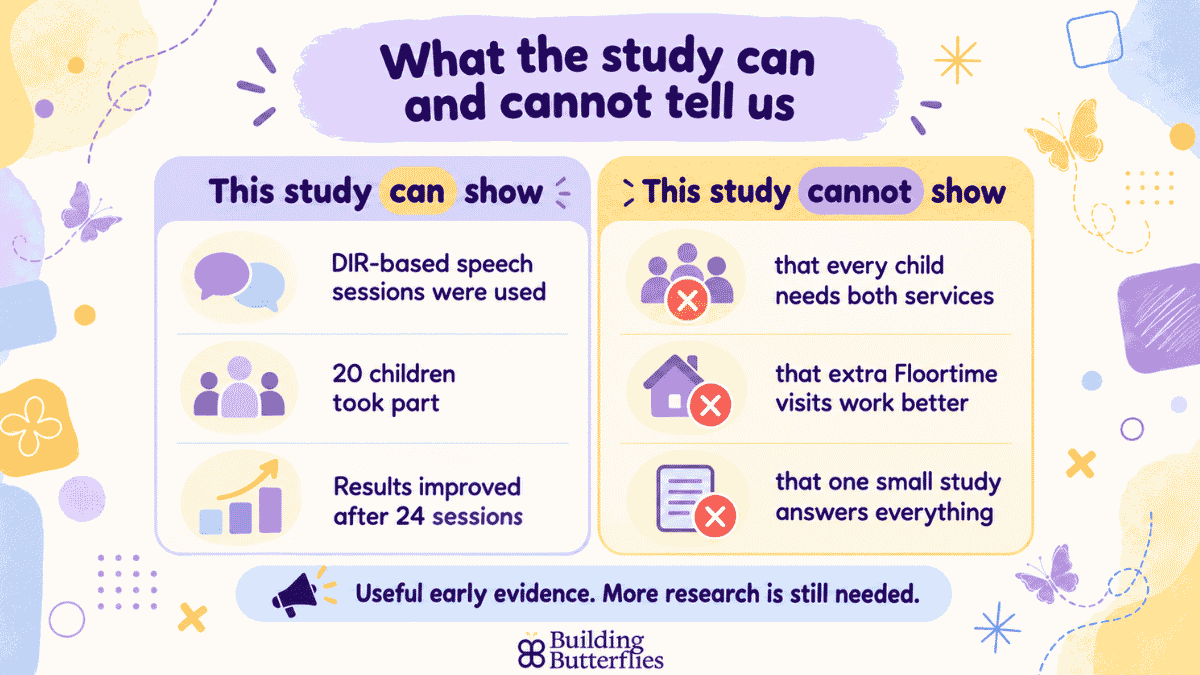
A 2025 study of DIR-based speech-language intervention followed 20 young children through 24 intervention sessions. Researchers reported improvements in communication and interaction measures when they compared the children’s results before and after treatment.
The study examined speech therapy using DIR principles. Its design does not establish that adding separate Floortime appointments produces better results than speech therapy alone. The findings support further research, without prescribing one combination of services for every child.
An additional service should address an identified need. These questions can help families understand the proposal:
DIR training supplements a provider’s existing profession. ICDL’s certificate and scope-of-practice information explains that a DIR certificate does not grant a separate professional license or expand someone’s licensed responsibilities.
DIR Floortime and occupational therapy may also address connected needs. An occupational therapist, or OT, can assess sensory and movement needs that affect participation, such as posture or motor planning during a shared activity. ICDL includes speech and occupational therapy within its description of a coordinated DIR program.
Our clinic-based DIR Floortime services include a multidisciplinary approach involving speech-language, occupational therapy, and educational strategies. Multidisciplinary care means professionals from different fields contribute their skills; each child’s plan still needs defined responsibilities.
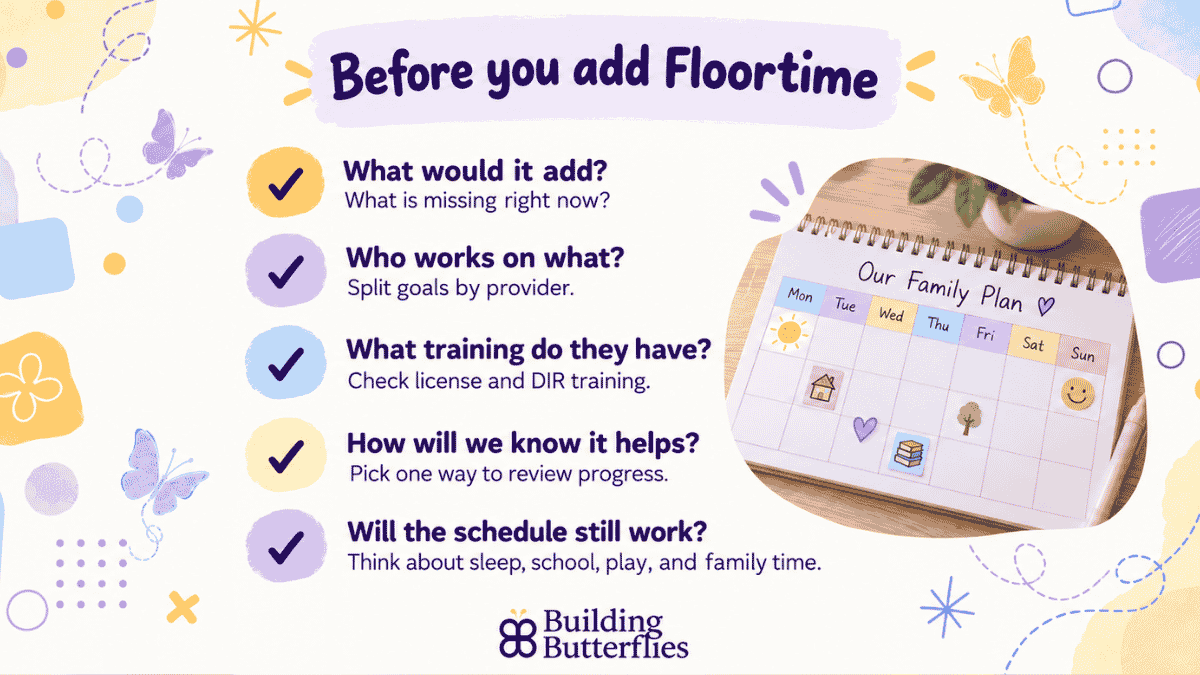
An SLP with appropriate DIR training can use Floortime principles within speech-language practice. The therapist’s professional credentials and DIR training describe different qualifications, so families can check both.
AAC, or augmentative and alternative communication, can remain available during Floortime. Pictures, signs, and speech-generating devices can support shared activities. ASHA states that AAC has no required starting skills. Our overview of Floortime for nonspeaking children explains these options further.
The providers should explain what each strategy aims to support and agree on instructions the family can follow. A specific example helps: “One therapist asks us to wait, and another asks us to offer help right away.” A joint conversation can address when each response applies.
DIR Floortime and speech therapy can address connected needs when each service has a purpose. Shared goals help the adults around your child understand what to practice and notice.
At Building Butterflies, we provide DIR Floortime support in New Jersey through home, school, and clinic services. Our team can speak with you about your child’s current therapies and where our communication and interaction support may contribute.

Your child holds incredible potential. At Building Butterflies, we use DIR Floortime Therapy to nurture development at the root, not just the surface, helping them connect, communicate, and flourish.
Contact us now to find out if your child can benefit from DIR Floortime Therapy.


©2026 Building Butterflies. All rights reserved.
Website Created By: Summit Group
