How DIR Floortime Builds Social-Emotional Skills in Children With Autism: A Guide for NJ Families
DIR Floortime social emotional development supports regulation, shared attention, and child-led play. See how skills can grow across daily routines.

DIR Floortime social emotional development supports regulation, shared attention, and child-led play. See how skills can grow across daily routines.
Key Points:
Watching your child play can sometimes feel like looking at a world you are not invited to join. You might notice they prefer to line up blocks alone or seem to tune out when you call their name.
These moments often lead to a search for DIR Floortime social emotional development strategies that feel natural rather than forced. Many children on the spectrum may need social-emotional development therapy for sharing attention, taking turns, or handling big feelings when things change .
"Social-emotional skills" can sound like a clinical term, but it shows up in everyday moments. Think about a child who glances back at a parent after doing something exciting, or who hands over a toy because they want to share the fun. That's social-emotional growth in action.
In DIR Floortime therapy, where DIR stands for Developmental, Individual Difference, Relationship-based, these skills include:
According to the International Council on Development and Learning (ICDL), these are part of what's called "functional emotional developmental capacities," the building blocks of how children learn to connect, communicate, and think.
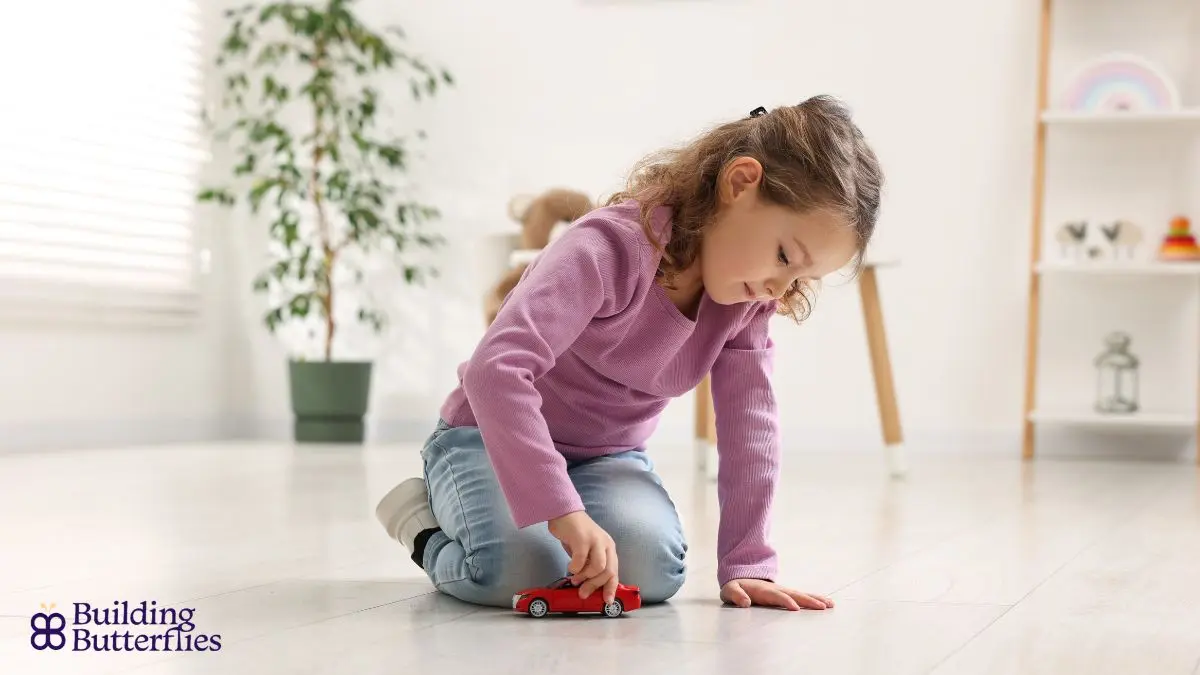
Here's what makes this approach stand out: it follows the child's lead first. The therapist or caregiver joins whatever the child is already doing, even if that's lining up toy cars, and then gently expands the interaction.
That simple car line can turn into:
This is very different from asking a child to sit and practice a skill that feels disconnected from what they care about. The goal in DIR Floortime play therapy is to increase what practitioners call "circles of communication," or the back-and-forth exchanges that form the core of social connection.
It is hard to learn how to share or talk if you feel like the world is too loud, too bright, or too confusing. This is why social emotional development therapy in New Jersey focuses on the child's "internal engine" first.
A child who is dysregulated might cry, shut down, or move constantly. They aren't being "bad"; their bodies are just trying to find balance. DIR Floortime often starts with co-regulation. That means the adult helps the child settle through the right pace, tone, movement, sensory support, and relationship cues.
One CDC report showed that 66.5% of 8-year-old children with autism had a documented autism test, with wide differences by location, including 24.7% in New Jersey and 93.5% in Puerto Rico. That gap shows why a diagnosis alone does not explain a child’s full profile.
DIR Floortime uses developmental capacities to understand how children grow socially and emotionally. Here’s the simple version parents need to know:
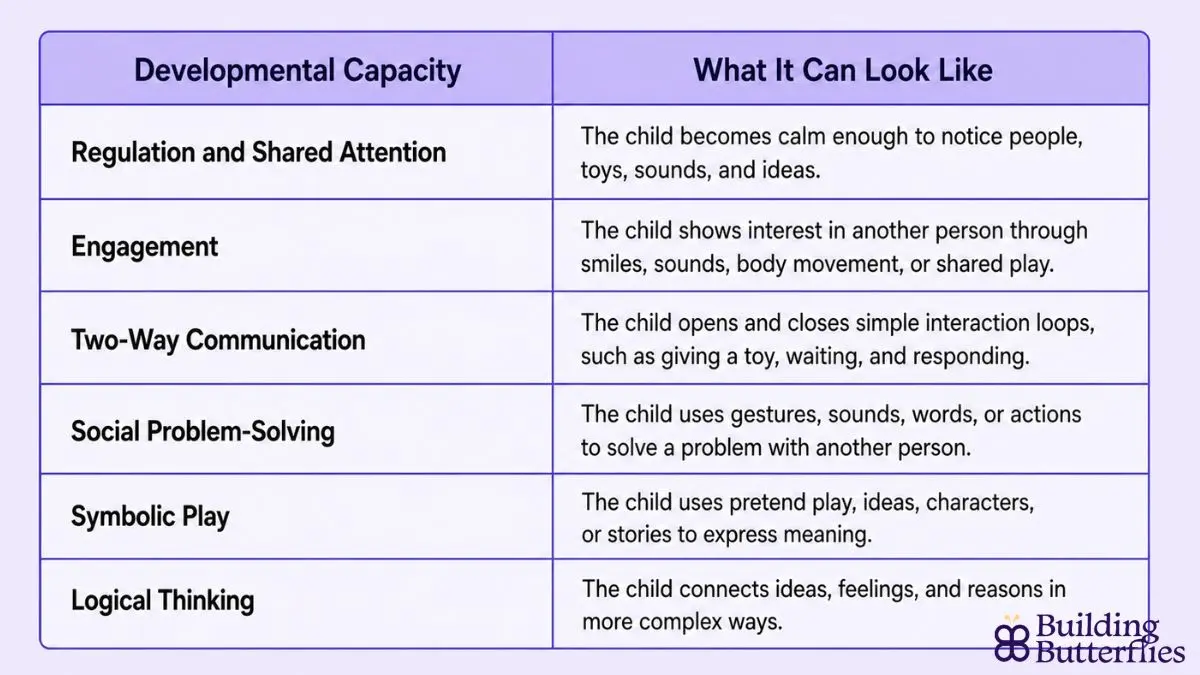
Progress may look small at first. A shared smile, a longer pause, or a child handing over a toy can be part of deeper social growth. In DIR Floortime social skills NJ services, those small moments often become the base for communication and interaction.
Parents often ask: "How will I know if it's working?" The signs won't always be dramatic, but they're real.
Here's what many families begin to notice:
At Building Butterflies, we offer DIR Floortime social emotional development therapy in New Jersey, with Monmouth County support across home, school, and clinic settings, so these gains can carry over into the environments where children spend most of their time.
DIR Floortime works best when caregivers understand the child’s cues and use the approach during daily routines. A therapy session can help, but children also need many small chances to connect outside therapy.
DIR Floortime parent training can help caregivers use Floortime ideas during:
The PLAY Project randomized trial found positive effects on parent-child interaction and children’s social engagement when parents were coached in a relationship-based model for young children with autism.
Families searching for DIR Floortime therapy in New Jersey are asking more questions because autism support needs remain high. CDC supplementary data reported that 34 out of every 1,000 8-year-old children in New Jersey were identified with autism in 2022, up from 28.7 per 1,000 in 2020.
That local need gives families a reason to look beyond isolated skill practice. Social emotional development therapy in New Jersey can support children through emotional regulation, communication, relationships, and problem-solving.
For many children, those areas work together. A child who feels more regulated may be more ready for communication and social growth through noticing others, sharing ideas, and joining play.
Yes. DIR Floortime therapy supports social skills by helping children build shared attention, engagement, two-way communication, flexible thinking, and relationship-based problem-solving. Because the approach meets children at their developmental level, gains in social interaction tend to feel natural rather than scripted.
Yes. DIR Floortime therapy supports emotional regulation by helping caregivers and therapists respond to a child's sensory, emotional, and relationship cues before expanding interaction. Co-regulation, or staying calm and present with the child, is built into the approach from the start.
No. DIR Floortime therapy can support children at different developmental stages because the model follows the child's current emotional, social, sensory, and communication profile, and not their age. Children who are older or at different developmental levels can still benefit from this relationship-based approach.
Social-emotional growth in children with autism doesn't come from drilling skills in a chair. It grows through safe relationships, play that feels meaningful, and adults who know how to follow a child's lead.
At Building Butterflies, we work with families across New Jersey, including Lakewood, Toms River, Hoboken, Edison, Hackensack, Newark, and Monmouth County, to provide DIR Floortime therapy that supports social and emotional development through relationship-based play. Families can choose from home, school, and center-based settings depending on what fits best.
If you're ready to see what's possible for your child, reach out to us today. We'll talk through where your child is, what they need, and how we can build something meaningful together, one interaction at a time.

Your child holds incredible potential. At Building Butterflies, we use DIR Floortime Therapy to nurture development at the root, not just the surface, helping them connect, communicate, and flourish.
Contact us now to find out if your child can benefit from DIR Floortime Therapy.


©2026 Building Butterflies. All rights reserved.
Website Created By: Summit Group
