No, It’s Not Just Playing: What DIR Floortime in Edison, NJ Really Involves
DIR Floortime Edison NJ turns child-led play into planned work on regulation and communication. The session breakdown shows what therapists track.

DIR Floortime Edison NJ turns child-led play into planned work on regulation and communication. The session breakdown shows what therapists track.
Key Points:
DIR Floortime in Edison, NJ uses play as a clinical tool, not as a break from therapy. A practitioner follows your child’s interests while observing regulation, engagement, communication, sensory responses, and problem-solving. Child-led care does not mean unplanned care.
An Edison session may include cars, bubbles, movement, or a familiar routine instead of worksheets. The clinical work appears in how we enter the activity, time each response, and expand the interaction.
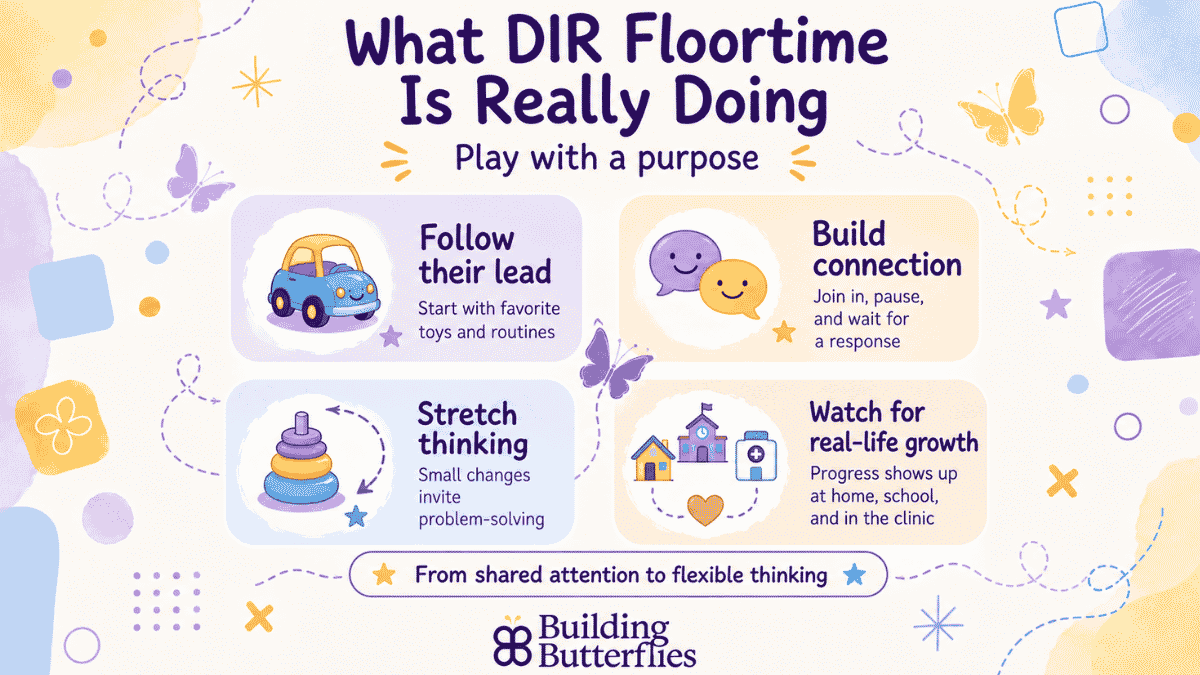
The Developmental, Individual-differences, Relationship-based (DIR) model provides the core framework for this work, while Floortime is the practical application. Instead of forcing a child into a set routine, this framework focuses on building developmental capacities, respecting unique sensory processing styles, and using relationship interactions to support learning.
In Edison, sessions can happen around familiar toys at home, classroom settings at school, or specialized spaces in a clinic. The setting may look casual, but our team keeps every response and pause deliberate. We offer all three session formats so your family can choose what fits best.
During a session, a DIR Floortime therapist in Middlesex spends every minute observing subtle cues. This continuous observation helps guide what action to take next.
Before a child can stay engaged, their nervous system must feel calm and steady. Our team pays close attention to individual sensory differences:
Communication involves far more than spoken words. A glance, gesture, movement, sound, or action all count. We respond to these cues and wait, giving your child space to send the next message.
Once connection is established, we gently introduce slight changes. Moving a toy or adding a simple obstacle tests your child's emotional regulation and shared problem-solving.
One family we worked with felt stuck because their child would walk away whenever an adult tried to direct his play. During our early sessions, we joined his routine of spinning toy wheels by sitting quietly beside him and gently spinning a second wheel. Within two weeks, he stopped walking away and began looking at us to start the activity together.

Consider a moment involving repetitive play patterns, where a child lines up toy cars and spins a single wheel. From across the room, it looks like a solitary habit. During a session, this exact moment becomes an opportunity for connection.
Whether this happens during in-home DIR Floortime therapy in Edison, a school day, or a clinic appointment, the core process remains the same. The interaction may look almost unchanged from across the room, but the developmental change appears in that one added glance or accepted modification.
At Building Butterflies, our team can explain what each playful interaction is targeting and how it relates to your child's developmental profile. Families can ask about home, school, or clinic sessions in Edison and Middlesex County, then discuss which setting matches their child's needs and daily routine. Contact our team to start the conversation.
Measuring success in DIR Floortime in Edison, NJ looks at developmental growth rather than how many tasks a child completes. A 2023 systematic review of 12 studies reported improvements in social-emotional functioning, communication, daily living skills, and parent-child interaction, though researchers note that broader clinical trials are still needed.
We track progress by observing real growth across several key areas:
After a session, caregivers can ask us specific questions to understand the progress being made:
Caregivers may expect progress to appear as a new word or completed task. Our team also watches for early communication and interaction gains, such as staying connected longer, returning after a break, or inviting an adult into an activity.

Families exploring autism therapy in Edison, New Jersey often notice progress during daily routines before seeing it in formal settings. Skills built during play show up naturally when your child feels comfortable applying them at home.
You may begin noticing these subtle shifts in everyday life:
A single new gesture does not mean full mastery right away. Repeated patterns across morning routines, meals, and playtimes give us a true picture of your child's development. Observations from home, school-based sessions, and clinic appointments show different parts of a child's growth, and our team compares notes across these settings to keep support consistent.
Choosing the right environment helps your child feel safe enough to engage. We offer options across three distinct settings to fit your family's daily routine:
If you are searching for DIR Floortime near me in Edison, we support families across North Edison, South Edison, Clara Barton, Oak Tree, and Menlo Park Terrace. We also deliver autism support across Edison and nearby New Jersey communities, including Woodbridge, Piscataway, New Brunswick, and Metuchen.
Choosing DIR Floortime in Middlesex County through our team means finding the exact setting where your child feels most confident.

Yes. DIR Floortime treats communication as much more than speech. A look, gesture, movement, sound, or action can start a back-and-forth exchange. We start with the communication methods your child already uses and build from there. Many parents we support are relieved to see how quickly nonverbal interactions turn into meaningful connections.
Yes. DIR Floortime coordinates well with speech, occupational, and sensory therapies. Each professional focuses on their specialty while sharing goals across your child's care team. In our work, having open communication between providers helps children build skills faster across all their daily routines.
We accept several insurance plans for Edison services. Coverage depends on your specific plan, session setting, and authorization requirements. Our intake team verifies your benefits and explains any necessary documentation before scheduling your child's first session.
Purposeful play becomes easier to understand when you can see the developmental goals behind each interaction. At Building Butterflies, we provide DIR Floortime in Edison and nearby Middlesex County communities through in-home, school-based, and clinic sessions.
Call (973) 899-1816 or email info@buildingbutterflies.com. Our team will learn about your child, review any existing evaluations, discuss your family's goals, and explain which available setting matches your child's needs and routine.

Your child holds incredible potential. At Building Butterflies, we use DIR Floortime Therapy to nurture development at the root, not just the surface, helping them connect, communicate, and flourish.
Contact us now to find out if your child can benefit from DIR Floortime Therapy.


©2026 Building Butterflies. All rights reserved.
Website Created By: Summit Group
