Getting an Autism Diagnosis in New Jersey: Who to Call First
Autism diagnosis New Jersey starts with pediatric screening and the public program for your child’s age. See who to call first and what to prepare.

Autism diagnosis New Jersey starts with pediatric screening and the public program for your child’s age. See who to call first and what to prepare.
Key Points:
If you searched for autism diagnosis in New Jersey, call your child’s pediatrician first. During the same week, contact the public evaluation program for your child’s age: New Jersey Early Intervention for children under 3 or your local school district for children 3 and older.
Families asking where to get autism diagnosed in New Jersey can start both options at once. At Building Butterflies, we provide DIR Floortime developmental therapy after evaluation and do not diagnose autism. Caregivers have told us they felt nervous before support began, so a clear first step can help.
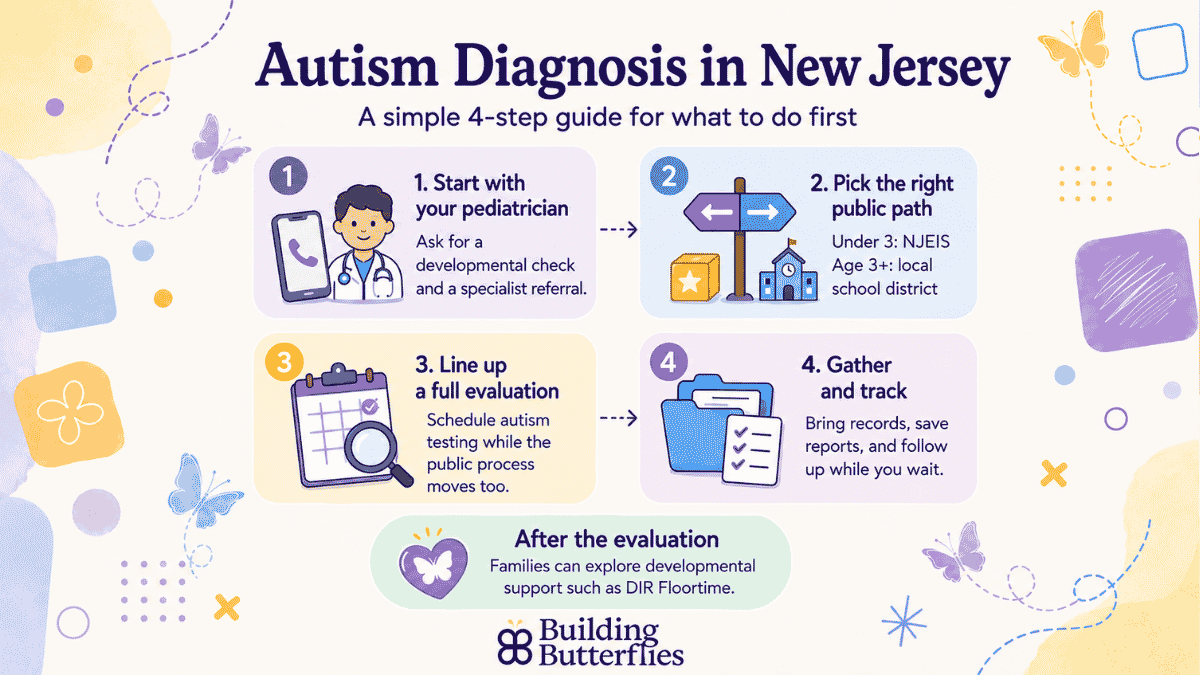
A medical diagnosis and eligibility for public services involve separate processes. A pediatrician or diagnostic specialist handles the medical evaluation. The New Jersey Early Intervention System (NJEIS) or your local school district assesses eligibility for public services.
Here are the basic autism diagnosis steps New Jersey parents can follow:
When calling your doctor's office, a short script can help: "I have concerns about my child’s communication, play, sensory responses, or social development. I would like a developmental screening and a referral for an autism evaluation."
Your pediatrician can complete a screening, review developmental history, rule out immediate medical concerns, or refer you to a specialist. The American Academy of Pediatrics recommends screening at 18- and 24-month visits, but you can raise concerns at any age.
To prepare for a child autism assessment in New Jersey, pediatricians recommend bringing specific examples instead of relying on memory:

If your child is under 3 years old, contact the New Jersey Early Intervention System. You can request an evaluation whenever you suspect a developmental delay. A medical diagnosis is not required before calling. The NJEIS process examines developmental needs and service eligibility rather than giving a medical diagnosis.
Have these details ready when you make the call:
An early autism diagnosis NJ evaluation and Early Intervention run on separate tracks. Keep your specialist appointment even if NJEIS starts first.
Contact the special services department in your local public school district and ask for the Child Study Team. Send a written request describing the communication, behavioral, or learning concerns that led you to seek an evaluation. If you do not know which district office to contact, call Project Child Find.
Keep these differences in mind:
Your pediatrician may refer your child to a developmental-behavioral pediatrician, neurodevelopmental pediatrician, child psychologist, child psychiatrist, pediatric neurologist, or a multidisciplinary clinic.
An autism evaluation NJ specialists perform relies on caregiver interviews, developmental history, clinical observation, and formal testing tools. No blood test or scan alone diagnoses autism.
Bringing complete records helps the evaluator understand your child:
For an autism evaluation, families in Hackensack and Newark often turn to major medical centers like the Rutgers New Jersey Medical School Autism Center in Newark or the Institute for Child Development at Joseph M. Sanzari Children’s Hospital in Hackensack. Call ahead to check referral rules, insurance policies, age limits, and current waiting periods.

A long waiting list for a specialist should not pause your public evaluation. You can keep your specialist appointment while working with NJEIS or your local school district.
Stay active while waiting by following these actions:
One family we worked with felt stuck on a six-month waiting list for a specialist in Bergen County. Once they set up their public evaluation and started exploring simple developmental play strategies at home, that waiting window shifted from feeling like lost time to building active support.
Building Butterflies does not provide autism diagnoses. Families who have completed an evaluation and are beginning to compare developmental therapy options can contact our team to learn how DIR Floortime works across home, school, and clinic settings.
A diagnostic report may recommend services for communication, emotional regulation, sensory needs, or social play. DIR Floortime uses child-led play and caregiver relationships to support those developmental areas.
At Building Butterflies, we provide home, school, and clinic services across New Jersey, including DIR Floortime in Newark and Hackensack.
Parents often report these experiences after starting therapy:
A parent recently shared that during their first session with us, watching their child laugh while taking the lead in a game was the moment the diagnosis stopped feeling like a label and started feeling like a way forward.

Insurance rules vary by plan. Call member services to ask if your evaluator must be in-network, whether a referral is required, and which services need prior approval. When families ask us about insurance, we always suggest calling the number on your card first.
Request the written report. The evaluation may still identify communication and interaction needs, sensory differences, learning needs, or attention needs. Ask your clinician which services, follow-up checkups, or future re-evaluations they recommend based on those specific findings.
Yes, evaluations are available beyond early childhood. Diagnostic evaluations for older children and teens rely on school history, social experiences, past reports, caregiver interviews, and the child’s account of daily challenges.
Your first two phone calls can start on the same day: your child’s pediatrician and the New Jersey public evaluation system for their age. A specialist evaluation can proceed while those initial steps get underway.
At Building Butterflies, our focus begins with developmental support rather than diagnosis. Our team provides DIR Floortime in home, school, and clinic settings across New Jersey. Call (973) 899-1816 or email info@buildingbutterflies.com. Our intake team will ask about your child’s age, location, insurance, evaluation recommendations, and preferred setting before explaining current availability.

Your child holds incredible potential. At Building Butterflies, we use DIR Floortime Therapy to nurture development at the root, not just the surface, helping them connect, communicate, and flourish.
Contact us now to find out if your child can benefit from DIR Floortime Therapy.


©2026 Building Butterflies. All rights reserved.
Website Created By: Summit Group
