7 Signs Your Child May Need DIR Floortime Therapy
Signs a child needs Floortime therapy often appear in play, regulation, and communication. See what patterns to track before choosing support.

Signs a child needs Floortime therapy often appear in play, regulation, and communication. See what patterns to track before choosing support.
Key Points:
he signs a child needs Floortime therapy typically show up as patterns across communication, play, emotional regulation, and social connection. These behaviors are not a medical diagnosis. Instead, they help parents decide whether a relationship-based, child-led approach fits their child's daily life.
Developmental, Individual Differences, Relationship-based (DIR) Floortime may fit when a child needs support with shared attention, flexible play, emotional regulation, sensory comfort, and back-and-forth interaction. In New Jersey, where about 1 in 34 children receives an autism diagnosis, finding a model that values connection over compliance matters to many local families.
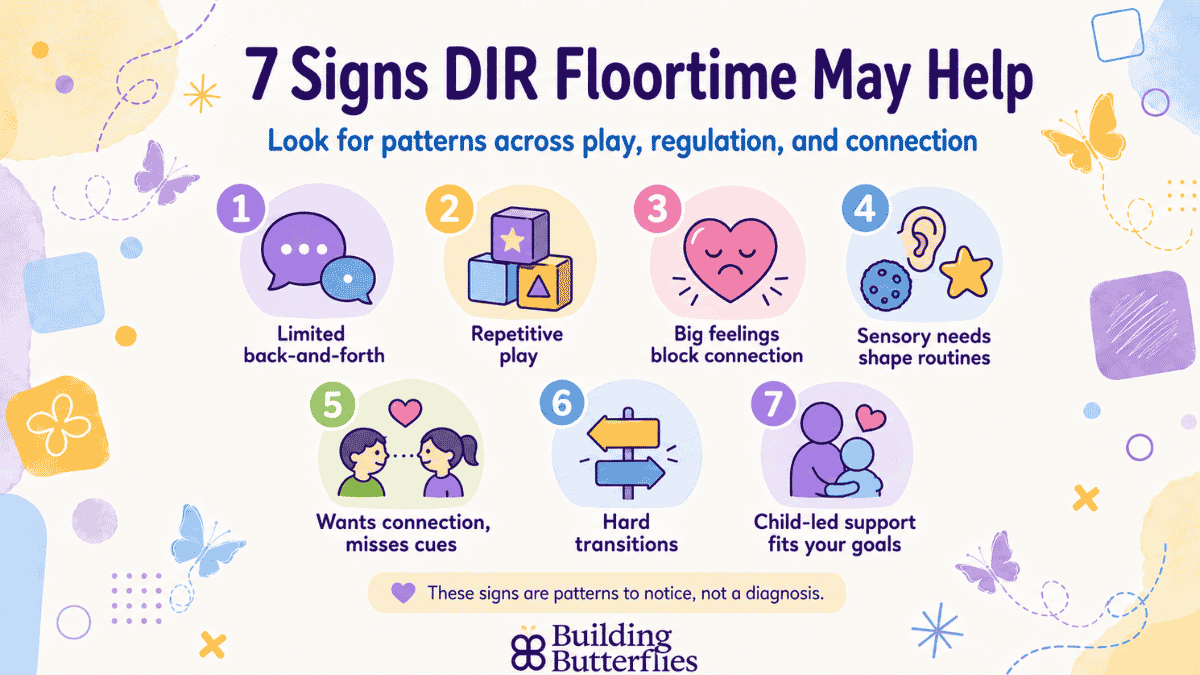
Communication involves much more than spoken words. Parents asking, “Does my child need DIR Floortime?” often notice that communication feels one-sided. Your child might use words, scripts, or sounds without using them to connect directly with you. Many children may pull a parent's hand to an object or repeat phrases from a favorite show only to communicate an immediate need.
The National Institute on Deafness and Other Communication Disorders (NIDCD) states that communication challenges in autism can include problems with gestures, eye contact, and turn-taking. Floortime addresses this by building circles of communication, which means a continuous loop of action and response between you and your child.
Does your child play with toys the exact same way every time? Repetitive play is a common trait. The Centers for Disease Control and Prevention (CDC) lists repetitive play, lining up toys, and distress with minor changes as autism-related characteristics. The focus is not the repetitive interest itself. The concern arises when the play remains closed to shared attention. Floortime practitioners join the child's play exactly where it is to slowly expand it.
Emotional regulation forms the foundation for all learning. When to try Floortime therapy autism support? It is when regulation blocks connection. Many children may melt down, shut down, or run away when they face minor frustrations. They become difficult to reach during these moments.
The International Council on Development and Learning (ICDL) explains that Floortime supports self-regulation, engagement, and shared social problem-solving. In this framework, behavior communicates stress or sensory overload. Therapists focus on co-regulation first. We help your child feel safe and calm before introducing social expectations or communication goals.

Every individual processes sensory information differently. Children with autism often experience sensory inputs with intense clarity or feel under-responsive to them. The CDC notes that unusual reactions to sounds, textures, or lights are common characteristics. The DIR model looks closely at these individual differences before expecting social interaction.
At Building Butterflies, we help families look at the whole child. Our team focuses on regulation, sensory needs, communication, and play. We provide DIR Floortime services across New Jersey through home, school, and clinic-based support. You can talk with us about which specific setting fits into your family's daily life. Reach out today to share what you are seeing with your child at home.
Many parents worry that their child prefers to be alone. Often, the child wants to connect but lacks the tools to start. So who benefits from Floortime therapy autism support without overpromising? Children who want to interact but miss social cues can find Floortime support across New Jersey.
The CDC includes challenges like not sharing interests or failing to join peers in play as social communication signs

Moving from one activity to the next requires cognitive flexibility. Parents searching for signs DIR Floortime therapy is needed often describe transition stress across several routines. Your child might struggle intensely when leaving the house for school or stopping screen time. The CDC notes that distress over minor changes forms part of restricted or repetitive behavior patterns.
Floortime does not focus on forcing compliance during these shifts. Instead, the approach uses the relationship to support shared problem-solving. We build emotional stability so your child can handle changes more easily.
Choosing a therapeutic model depends heavily on your family values. The ICDL describes Floortime as a relationship-based model utilized by parents, teachers, and therapists. Floortime therapy can be a good fit for a child with autism when shared engagement and regulation, along with child-led interaction, are central goals. Research suggests that active caregiver coaching helps build these developmental blocks at home.

Yes. DIR Floortime can sit alongside speech therapy or occupational therapy when providers coordinate goals. Speech sessions can target specific articulation, occupational therapy supports physical motor needs, and Floortime connects those elements through relational play.
No. Families seek Floortime for various developmental delays, sensory differences, or communication challenges. A formal diagnosis is useful for insurance documentation, but your initial consultation can focus entirely on your child's behavioral patterns at home and school.
Look for small shifts within a few weeks. Early DIR Floortime progress can include longer periods of eye contact, improved emotional recovery, or more back-and-forth gestures. A pilot study showed noticeable improvements in child interaction after structured parent training programs.
Your child's play, emotional reactions, communication styles, and recovery after stress reveal exactly what kind of developmental support they need. A strong DIR Floortime plan reads these unique patterns before asking a child to perform complex new skills.
At Building Butterflies, we provide DIR Floortime therapy across New Jersey, including Montvale, Bergen County, Monmouth County, Lakewood, Toms River, Hoboken, Edison, Hackensack, and Newark. Call (973) 899-1816 or send a message through our online contact form. Our team will review your child's needs, answer your questions, and help you determine the best next step for your family.

Your child holds incredible potential. At Building Butterflies, we use DIR Floortime Therapy to nurture development at the root, not just the surface, helping them connect, communicate, and flourish.
Contact us now to find out if your child can benefit from DIR Floortime Therapy.


©2026 Building Butterflies. All rights reserved.
Website Created By: Summit Group
