DIR Floortime vs ABA: How to Choose a Program for Your Child
DIR Floortime vs ABA choices depend on each child. Provider questions and a worksheet help families compare programs.

DIR Floortime vs ABA choices depend on each child. Provider questions and a worksheet help families compare programs.
Key Points:
DIR Floortime vs ABA decisions should consider your child’s daily needs, the proposed goals, and what happens during sessions. Two providers using the same therapy name may work differently, so a program’s label tells only part of the story.
The questions and worksheet below can help you compare providers before starting services. They also offer a starting point when your child already attends therapy and you want to review the plan.
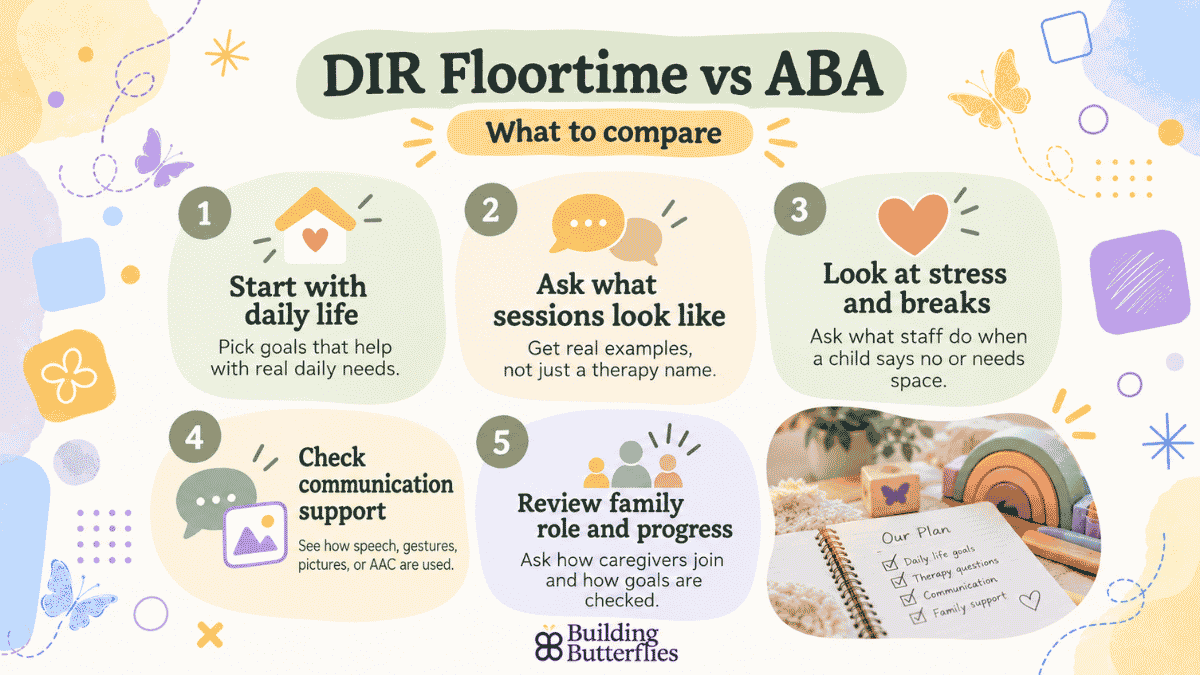
DIR stands for Developmental, Individual Differences, and Relationship-Based. Floortime puts that model into practice through interaction that follows a child’s interests and supports development. ABA, or applied behavior analysis, uses principles of learning and behavior to teach skills and measure changes. Some ABA approaches use play and everyday activities.
Both approaches may address communication, but their methods can differ. Our separate comparison of therapy methods and parent roles explains those differences in more detail. Here, the focus is how to evaluate a particular program.
A therapy goal should connect to something your child needs help with during an ordinary day.
For example, a child might point toward a closed snack container and become upset when nobody understands. A goal could involve requesting help through a gesture, sign, picture, speech, or communication device. Success does not have to mean saying a word.
Before a provider conversation, your notes might include:
At Building Butterflies, we support verbal and nonverbal interaction through our communication and interaction therapy. We follow children’s interests during play to encourage back-and-forth exchanges.
A provider’s answers should describe what happens during a session. An example involving your child’s needs can tell you more than a general description of the approach.
The provider should explain how staff notice distress and decide what to change. A child might cover their ears, move away, cry, or stop participating.
Questions to bring include:
For example, a child covering their ears during a loud game may need a quieter space. The provider’s response should address the situation and the child’s signals.
The team should explain how it responds to your child’s current communication methods and keeps communication tools available.
Pictures, signs, and speech-generating devices are forms of augmentative and alternative communication, or AAC. Children do not need to reach a certain age or demonstrate particular thinking skills before receiving AAC support.
A practical question is: “How would you help my child tell you that something hurts, that they need help, or that they want to stop?”
Caregiver participation should be understandable and realistic for your household. The provider can explain what family members will learn, what staff record, and when everyone reviews goals.
Questions might include:
Through our DIR Floortime parent coaching, we teach caregivers to notice their child’s signals and build interaction into play and daily routines.
The same questions give you a consistent way to compare two providers. Your notes can capture what each team proposes for your child.
Example only: A caregiver-role entry might read, “A parent joins part of the session and practices one activity with feedback.” The provider should describe its own arrangements.
Travel time, scheduling, and session location also belong in your decision. Convenience affects family life, but it does not establish the quality of care.
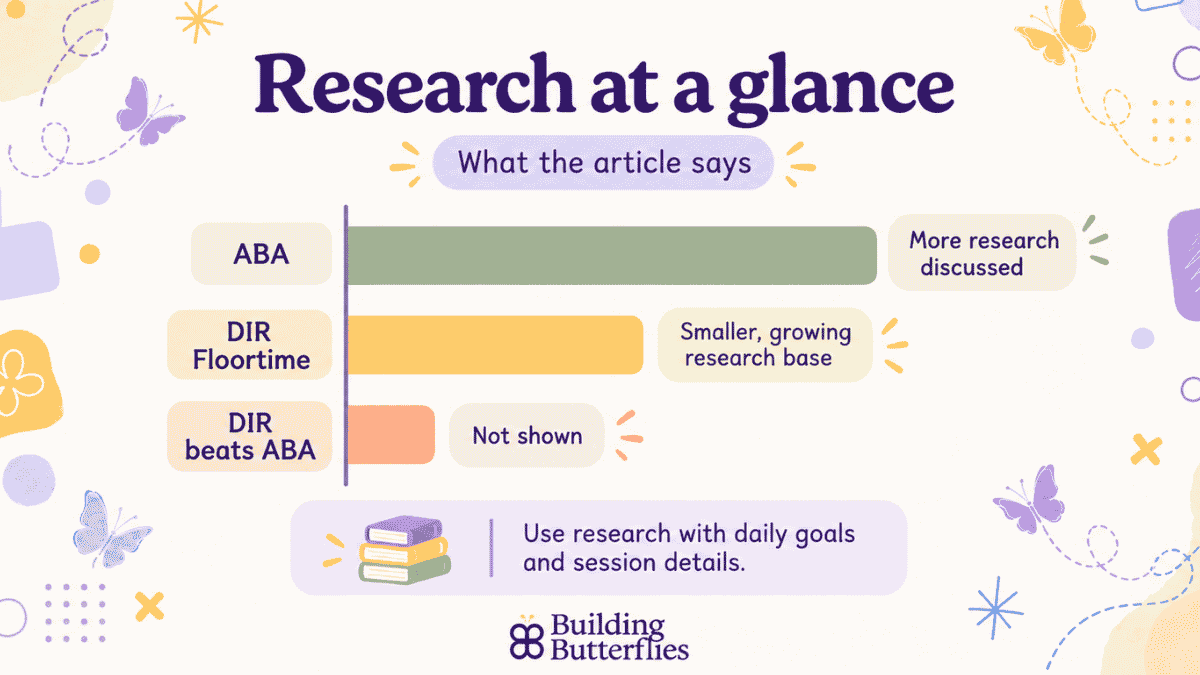
The evidence does not support treating DIR Floortime and ABA as equally researched approaches. The CDC treatment overview identifies behavioral approaches, including ABA, as having the most evidence for treating autism symptoms. That evidence does not guarantee results from every program.
DIR research needs equally careful interpretation:
Evidence about parent-led interventions as a broad category also cannot establish results for every DIR program. A provider discussing research should identify what researchers tested, who participated, and what changed.
A progress review should connect recorded changes with the goals your family and care team agreed on. Your child’s experience during sessions and daily life belongs in that review.
Short notes over a week can help organize observations:
These notes support a conversation; they are not a formal assessment. One difficult session does not determine whether a program helps, and a short-term improvement alone does not prove that therapy caused it.
Repeated distress, limited use of skills outside sessions, or goals that no longer reflect daily needs call for a conversation with the team. A review can address changes to activities, goals, support, or setting.
We offer DIR Floortime in New Jersey through home, school, and clinic services. Our in-home therapy brings support into familiar routines and includes caregiver participation.
School concerns may call for a different conversation. Through our school-based DIR Floortime support, we offer classroom observation and teacher collaboration. Those services can help a family explore support where difficulties arise, such as classroom activities or interactions with classmates.
A child may receive services using both approaches. Families and providers need to coordinate goals, check for conflicting instructions, and consider the demands of the combined schedule. Receiving both does not automatically produce better results. The decision should reflect the child’s needs and the proposed plans.
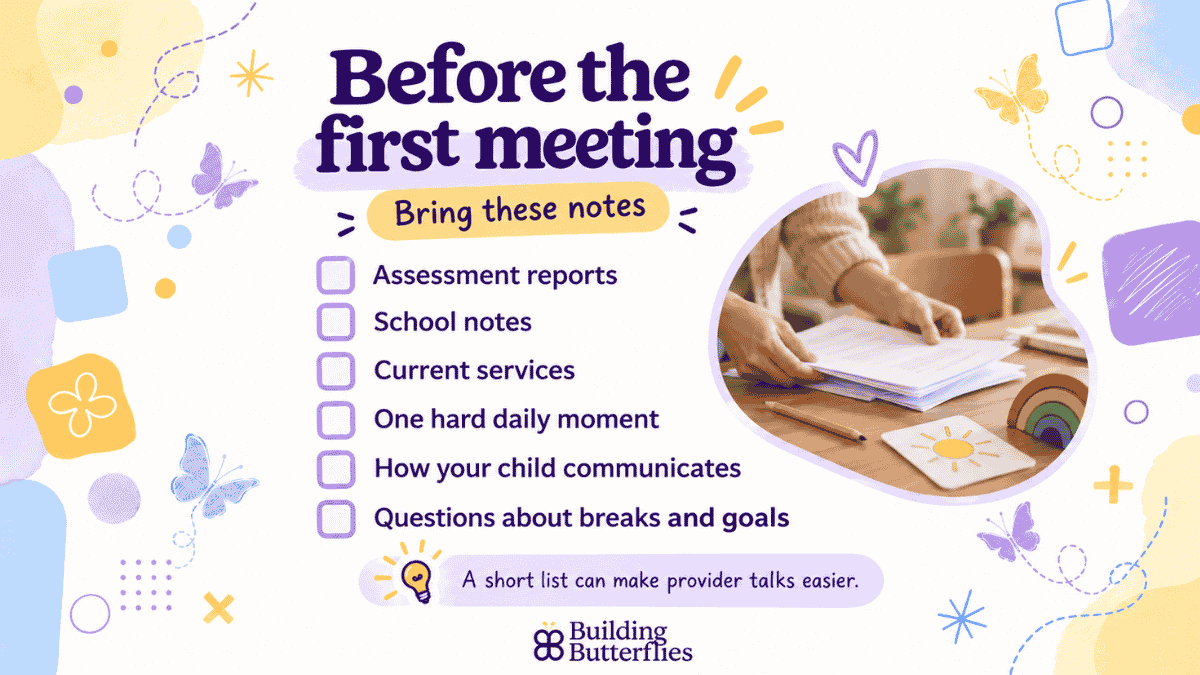
Existing assessment reports, school reports, and a list of current services can give the provider context. Information about your child’s interests, communication tools, and previous therapy experiences can also help. The provider can explain which records it needs and how to share them securely.
Coverage can differ by service, insurance plan, provider network, and authorization requirements. Your insurer can explain benefits for each proposed service. Our team can help check insurance information for Building Butterflies’ DIR Floortime services; coverage for one therapy does not establish coverage for another.
A program comparison works best when it connects your child’s daily needs with specific provider answers. Your worksheet can keep goals, session experiences, and family expectations together for that conversation.
At Building Butterflies, we provide DIR Floortime therapy for families in New Jersey. Our team welcomes questions about service settings, communication support, and caregiver coaching so you can understand the options we offer.

Your child holds incredible potential. At Building Butterflies, we use DIR Floortime Therapy to nurture development at the root, not just the surface, helping them connect, communicate, and flourish.
Contact us now to find out if your child can benefit from DIR Floortime Therapy.


©2026 Building Butterflies. All rights reserved.
Website Created By: Summit Group
