DIR Floortime for Teenagers in New Jersey
DIR Floortime for teenagers uses hobbies and daily life. Sessions can reflect teen needs, interests, and choices.

DIR Floortime for teenagers uses hobbies and daily life. Sessions can reflect teen needs, interests, and choices.
Key Points:
DIR Floortime for teenagers adapts a relationship-based approach to the interests and needs of adolescence. The approach extends beyond early childhood. An older child’s sessions can involve music, games, conversation, or shared projects, with support matched to how that person communicates and learns.
At Building Butterflies, we offer DIR Floortime in New Jersey through home, school, and clinic services. Our clinic-based program serves children through adolescence. A teen’s age, interests, and support needs all deserve attention when planning care.

Floortime for older children keeps the same focus on development, individual differences, and relationships. The adult joins an activity the young person enjoys and creates opportunities for interaction, shared thinking, and problem-solving.
The word “Floortime” can bring toys and play mats to mind. The broader approach uses interests and emotional connection to support development across ages. A teen’s interests provide the starting point for working together.
These examples show how an activity could connect to a teen’s goals. They illustrate possibilities, not accounts of our clients.
The activity alone does not make a session Floortime. The adult’s responses, the teen’s participation, and the developmental goal give the interaction its purpose.
DIR Floortime for adolescents can address relationships, identity, and independence. ICDL’s adolescent and adult training includes these areas alongside critical thinking and personal boundaries.
Goals might include:
A disagreement does not have to end with the teen accepting the adult’s view. The interaction can give both people room to explain themselves. A teen who communicates a boundary has contributed something important to that exchange.
Age-respectful support also leaves room for familiar interests. An older child may still enjoy toys, simple games, or repeated activities. Respect means taking those preferences seriously while choosing goals that reflect the person’s needs.
Our communication and interaction support focuses on back-and-forth exchanges through each child’s way of communicating. Words, gestures, and other responses can all be part of that work.
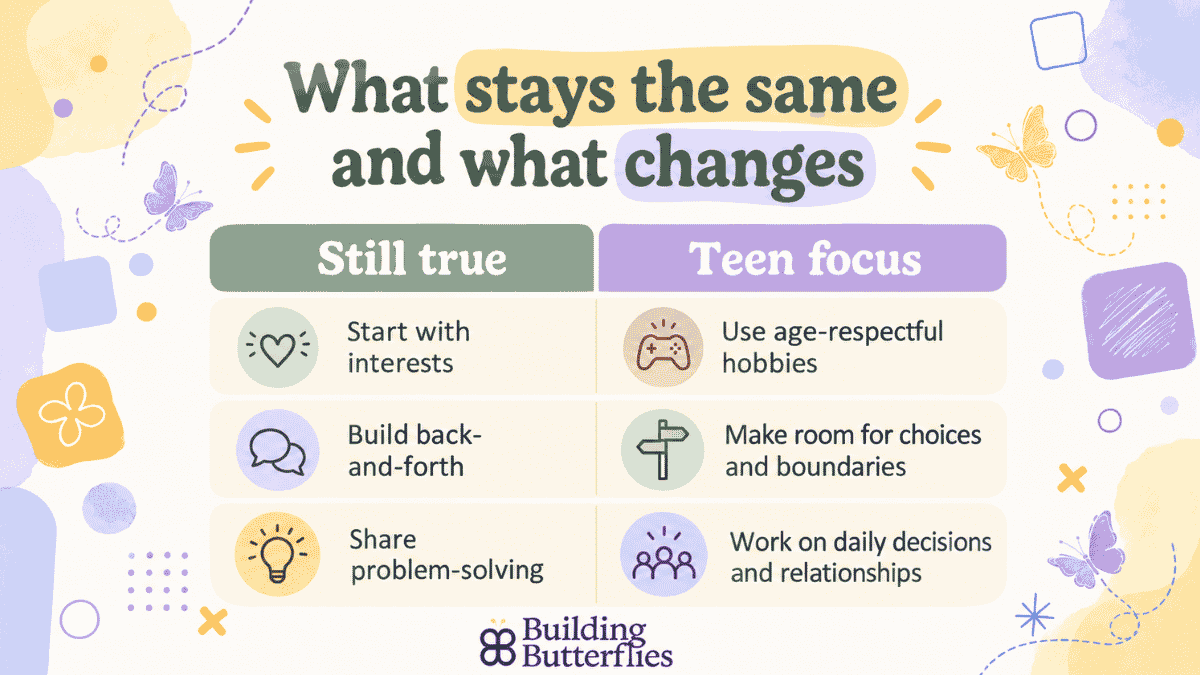
The setting gives families different opportunities to work on a teen’s priorities. A concern might involve sharing space with a sibling, joining a school activity, or explaining a preference during a conversation.
Through in-home DIR Floortime, we work within familiar surroundings and include caregivers in learning strategies. Our school-based support includes classroom observation and collaboration with educators. Those services connect developmental work with the places where children spend their days.
A parent can prepare for a conversation about care with two examples: something their teen enjoys doing with another person and an interaction that often becomes difficult. Those details make the concern easier to explain than a broad goal such as “better social skills.”
New Jersey requires transition planning in the Individualized Education Program, or IEP, for the school year when a student turns 14, or younger when appropriate. The planning considers the student’s strengths, interests, and preferences for life after high school.
Additional requirements for measurable goals after high school and transition services apply for the school year when the student turns 16, or younger when the IEP team considers it appropriate. The state’s transition-planning requirements explain both stages.
A teen interested in working with animals, for example, might want support explaining a need or asking someone to repeat an instruction. Developmental therapy and school planning may address related skills, but private therapy does not replace the school’s IEP responsibilities. Our article on requesting DIR Floortime in an IEP covers that separate process.
Research on DIR Floortime includes different ages and study designs. A 2023 systematic review included participants ages 2 through 19. The authors identified limitations, including few randomized controlled trials and differences between study groups that restricted how widely the findings could apply.
Mixed-age findings do not establish how well an approach works specifically for teenagers. ICDL’s adolescent training explains how professionals can apply the model; a training course does not establish treatment effectiveness.
For a family considering care, specific goals and progress reviews help keep the conversation practical. A question such as “How will we track whether my teen can explain a need with less help?” gives everyone something concrete to review.

Yes. Earlier Floortime participation is not a requirement of the model. DIR considers the person’s current development, individual differences, and relationships. An assessment helps determine whether the approach addresses the teen’s needs.
Yes. Fluent speech does not describe every part of communication. A teen may use long sentences but need support explaining feelings or exchanging ideas during disagreement. DIR includes engagement and shared thinking alongside communication.
No. The DIR framework also applies to adults, and ICDL offers training for that age group. The model’s use in adulthood is separate from an individual provider’s service age range. At Building Butterflies, our services include children through adolescence.
Teen Floortime can bring interests, relationships, and daily decisions into developmental work. The goals should respect the young person’s choices and provide a way to review whether the support helps.
At Building Butterflies, we offer home, school, and clinic services in New Jersey. A conversation with our team can begin with your teen’s interests, current concerns, and the situations your family wants help with.

Your child holds incredible potential. At Building Butterflies, we use DIR Floortime Therapy to nurture development at the root, not just the surface, helping them connect, communicate, and flourish.
Contact us now to find out if your child can benefit from DIR Floortime Therapy.


©2026 Building Butterflies. All rights reserved.
Website Created By: Summit Group
